Every ad platform you run wants full credit for the same sale. Meta says it was Meta. Google swears it was Google. Meanwhile, your customer found you through a podcast two months ago and doesn’t remember a single ad.
A how did you hear about us survey asks customers, usually right after checkout, where they first discovered your brand. Ask it as “How did you first hear about us?”, give 10 to 15 specific channel options plus “Other (please specify),” and pair it with “What brought you to our site today?” so you capture both first discovery and the final push to buy.
That’s the short version. The value is in the setup, so here’s the quick checklist, then the full guide.
TL;DR checklist
- Ask “How did you first hear about us?”
- Follow with “What brought you to our site today?” and “How long did you know about us before buying?”
- Name platforms, not categories (“TikTok,” not “Social media”)
- Randomize the order and keep “Other” last
- Use logic for follow-ups instead of adding more questions
- Show it to first-time customers
- Wait for a real sample, then read it next to your platform data, not instead of it
What is a “how did you hear about us” survey, and why ask it?
It’s one of the most common attribution questions brands run, and it belongs in the same family as the rest of your post-purchase survey questions. The customer tells you where they found you, in their own words, tied to a real order ID. That’s zero-party data: self-reported, first-hand, and attached to an actual buyer. It’s the kind of customer feedback that makes customer acquisition easier to read.
The reason it matters is simple. Pixels miss a lot, and online advertising platforms only count what they can see. Word of mouth, podcasts, creators, organic social media, TV, out-of-home, retail shelves, and now AI assistants all drive demand that never shows up cleanly in your analytics tools. AI discovery is the newest blind spot, and it’s growing fast. KNO’s 2026 AI Attribution Report found AI-driven discovery grew 1,150% in a single year, while most brands still have no way to see it in their reporting.
A how did you hear about us survey fills those gaps because you’re asking the one source that saw every touch: the customer.
Most brands run it on the Shopify Thank You or Order Status page, where attention is highest because the person just finished buying. You can also run it through a post-purchase email, a lead form, or a signup form, though each one measures a slightly different group.
One thing to keep straight: this survey is not a full attribution model. It’s one input. The best teams read it next to their other data, which we’ll get into below.
What exact question should you ask?
KnoCommerce (KNO) recommends a three-question core. Each one answers a different part of the journey.
- How did you first hear about us? This captures first discovery, how the customer remembers finding you. In attribution, memory is the point.
- What brought you to our site today? This captures the final push, closer to a last-touch signal.
- How long did you know about us before making your first purchase? This captures the consideration window. Ad platform reporting windows are usually shorter than real buying cycles, so this one keeps your expectations honest.
A few wording rules make the difference between clean data and mush:
- Keep “first” in question one. Drop it and customers answer with whatever they saw most recently.
- Stay neutral so you don’t lead people toward an answer.
- Use customer language, not your internal campaign names. “The spring launch” means nothing to a shopper.
- Make question one single-choice so your totals add to 100% and line up with your attribution model. Save multi-select for a separate “Where else have you seen us?” question.
You might see this written as a how did you find out about us survey or a how did you hear about us questionnaire. Same mechanics, same rules. If you want alternate phrasings, “How did you first find out about us?” and “Before you go, how did you first hear about us?” both work.
What answer options should you include?
Here’s the full taxonomy to pull from. Don’t use all 25. Pick the 10 to 15 that fit your brand, and add a follow-up only where it earns its place.
| # | Group | Answer option | Suggested follow-up |
| 1 | Social | Was it an ad, a creator, or a post from us? | |
| 2 | Social | Was it an ad, a creator, or a post from us? | |
| 3 | Social | TikTok | Who posted about us? Was it on TikTok Shop? |
| 4 | Social | YouTube | Which channel or creator? |
| 5 | Social | None | |
| 6 | Social | Which subreddit? | |
| 7 | Social | Snapchat or X/Threads | None |
| 8 | Creators | Influencer or creator | Who? (open text) |
| 9 | Creators | Podcast | Which podcast? |
| 10 | Search and AI | Google or other search engine | What did you search for? |
| 11 | Search and AI | AI assistant (ChatGPT, Gemini, Perplexity) | Which one? What did you ask? |
| 12 | Search and AI | Amazon or another marketplace | None |
| 13 | Word of mouth | Friend or family | Did they share a referral link? |
| 14 | Word of mouth | Saw someone using it | None |
| 15 | Word of mouth | Online community or forum | Which one? |
| 16 | Media | TV (cable or broadcast) | Show campaign stills |
| 17 | Media | Streaming TV (Hulu, Peacock, Netflix) | Which service? |
| 18 | Media | Billboard or out-of-home | Where? |
| 19 | Media | Radio or streaming audio | Which station or platform? |
| 20 | Media | Direct mail or catalog | None |
| 21 | Editorial | Article, blog, or review site | Which publication? |
| 22 | Editorial | Email newsletter (not ours) | Which newsletter? |
| 23 | In person | In a store | Which retailer? |
| 24 | In person | Event, pop-up, or sampling | Which event? |
| 25 | Other | Other (please specify) | Open text |
A few rules for building your own list:
- Name platforms, not buckets. “Social media” won’t tell you where to put your next dollar. “TikTok” will.
- Ask the platform first, ad versus organic second. Most customers can’t tell an ad from a regular post, so capture the platform, then split it in a follow-up.
- Randomize the option order to cut down on top-of-list bias, and pin “Other” to the bottom. KNO supports randomizing and a two-column layout.
- Review the list every quarter. If the same write-in keeps landing in “Other,” promote it to a real option.
For more question ideas across use cases, the ecommerce survey question examples guide and the post-purchase survey question bank are good places to pull from.
How should you handle “Other” and follow-up questions?
Follow-ups are how you add depth without making the survey longer for everyone. Only the people who pick a channel see its follow-up, and that extra tap gives you data you can actually act on.
Keep each follow-up to one short question. Use open text for names (creators, podcasts, search terms) and single choice where the list is known (which ad platform, which AI assistant).
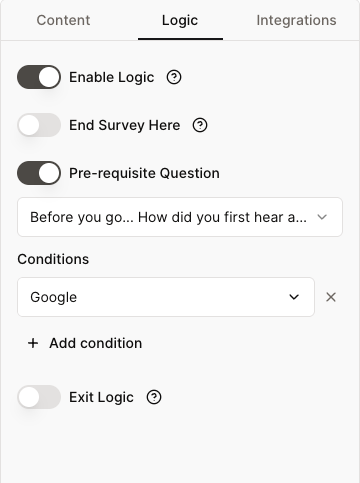
In KNO, conditional logic sits on the follow-up question, not the first one. You pick the prerequisite question, toggle Detailed Choice, and select the answers that trigger the follow-up. Several follow-ups can hang off a single answer. For “Other,” use the Other response option with a free-text field.
Then clean it monthly. Review the write-ins, add recurring ones as new options, and watch for misfiled answers (people type “Instagram” into the Other box more than you’d think). You can also save a group of customers by their first answer, say everyone who said TikTok, then read the “Who posted about us?” responses for just that group.
Smackin’ is a good example of follow-ups doing real work. They asked buyers what other snacks they’d want, and the answers made them realize they weren’t “just a sunflower seed brand,” which opened up new email segments. They also ran a question about their Flavor Pass: anyone who said yes got routed straight to the affiliate signup form. That one piece of logic helped onboard hundreds of new affiliates in a single month.

What’s the difference between first discovery and final conversion?
First discovery answers “what created demand.” Final conversion answers “what closed it.” They’re rarely the same channel, and the mistake is treating them like they are. Mapping both touch points shows you the real customer journey, not just the last step.
Read them side by side. Here’s what the common pairs usually mean:
| First heard about you via | Came to the site via | What it usually means |
| Social (TikTok, Instagram) | Google search | Search is validation, not origin. Don’t credit it with creating demand |
| Word of mouth | Email or SMS | Your nurture is converting referred demand |
| TV or podcast | Meta or TikTok ad | Offline is feeding paid social, a halo effect |
| Creator | Discount code | The creator drove interest, the code closed it. Credit both |
| Same channel for both | Same channel | A single-touch purchase, often impulse. Check question three |
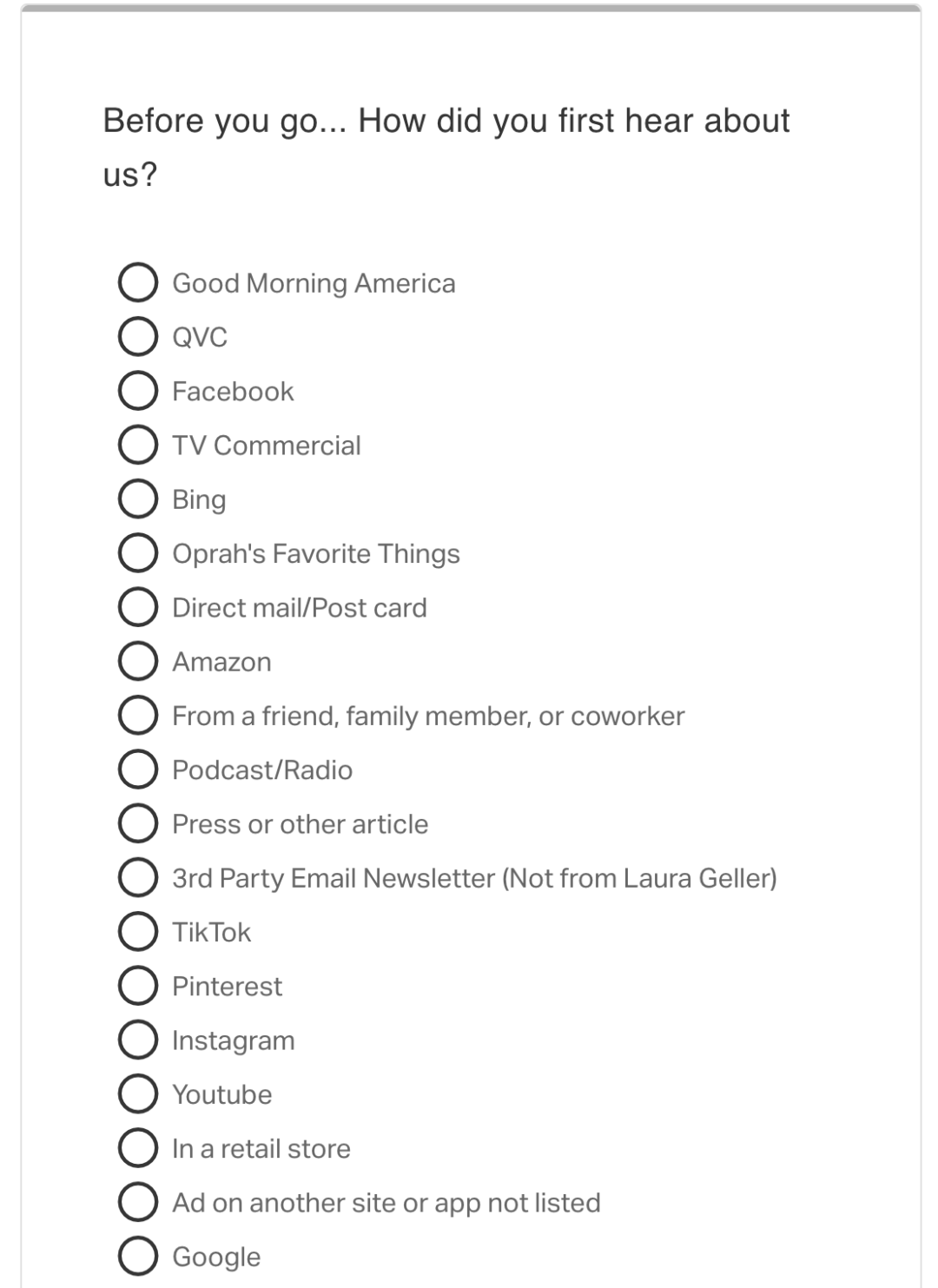
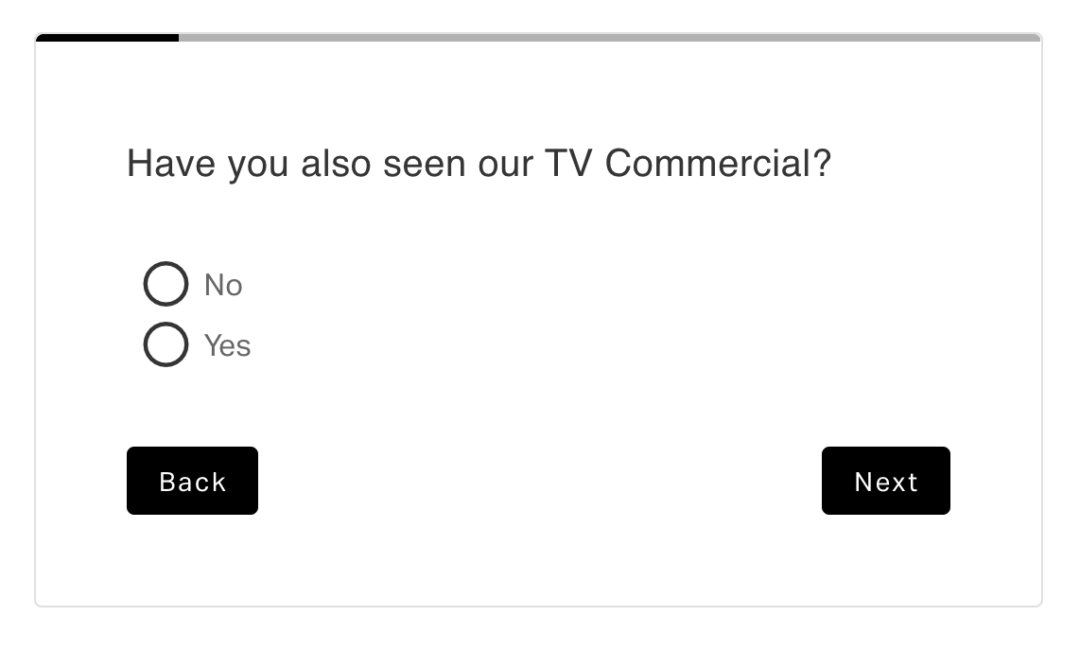
Laura Geller Beauty ran exactly this setup. They asked how customers first heard about the brand, then what brought them to the site. When someone said they discovered the brand on Facebook, TikTok, or Pinterest, a follow-up asked whether they’d also seen the TV commercial.
The pattern that surfaced: as TV spend went up, Facebook performance went up with it. TV was feeding digital. That one insight let them treat TV as a top-of-funnel engine rather than a cost center. TV drove 2.5 to 3x incremental revenue, the brand doubled its TV budget while holding ROAS targets, and TV became its second-biggest channel behind Meta.

For more on reading discovery against conversion, see how leading brands use post-purchase surveys.
What biases affect your data?
Self-reported attribution is strong data, but it isn’t perfect. Keep these biases in mind when you read your post-purchase survey data.
| Bias | What happens | How to reduce it |
| Nonresponse | Only some customers answer, and they may skew more engaged | Track response rate, compare respondents to all orders |
| Recall | People report the most memorable touch, not the first | Say “first” in question one, and ask questions two and three |
| Order (primacy) | Options near the top get picked more | Randomize options, pin “Other” last |
| List | The options you show shape the answers | Include organic channels, keep “Other,” review write-ins |
| Ad vs organic | Customers can’t tell an ad from a post | Ask the platform, then split ad vs organic in a follow-up |
| Buyer-only sample | You only hear from people who bought | Read alongside platform and lift data |
| Audience mixing | Returning customers muddy first-touch data | Target first-time customers |
| Incentive | A reward changes who responds | Skip incentives here, or compare with and without |
| Small sample | A few dozen answers swing wildly | Treat early results as directional |
How does survey attribution compare to other methods?
No single method sees the whole picture, and no single tool tells you which marketing campaigns actually created demand. The survey’s job is to see what the others can’t, and to calibrate them.
| Method | What it measures | Blind spots | Best for |
| Ad platform reporting | Conversions a platform like Meta or Google Ads claims, in its window | Self-crediting, platform overlap, no offline | Optimizing inside one platform |
| Google Analytics (GA4) / last-click | The last session before purchase | Over-credits search, direct traffic, and email | Site and funnel analysis |
| Multi-touch tools (Triple Whale, Northbeam) | Tracked touches across a journey | Can’t see untracked channels | Day-to-day paid spend |
| Marketing mix modeling | Spend vs sales over time | Needs lots of data, runs slow | Quarterly budget splits |
| Incrementality / lift tests | Causal lift from a channel | Costly, one channel at a time | Proving a channel works |
| How did you hear about us survey | What customers remember and say | Recall and response bias, buyers only | Seeing untracked channels, calibrating the rest |
If you’re weighing survey tools specifically, here’s how KNO compares to Triple Whale’s post-purchase survey.
How do you read it when the survey and your dashboards disagree?
Disagreement isn’t a problem to explain away. It’s usually the most useful signal you’ll get.
| What you see | What it usually means | What to do |
| Survey credits TikTok far above TikTok’s dashboard | TikTok creates demand that converts elsewhere | Check question two for those buyers, don’t cut TikTok on ROAS alone |
| Meta’s dashboard credits Meta far above the survey | View-through and retargeting credit | Compare first vs last touch for Meta orders |
| “Google” ranks high in the survey | Often a validation search after another touch | Check “What did you search for?”, branded search vs non-branded |
| Word of mouth is your top answer | Real, but the friend heard about you somewhere too | Add a referral-link follow-up |
| A channel you don’t pay for shows up | Earned or organic exposure | Read the follow-up names, consider testing paid there |
| Spend rises, survey share stays flat | Saturation or weak creative | Break it down by campaign period and creative |
You can also build a rough survey-modeled ROAS from this data:
- Take each channel’s share of question one (or two) for the month
- Multiply by that month’s revenue (new-customer revenue if you’re surveying first-time buyers)
- Divide by the channel’s spend for the month
- Compare with platform-reported ROAS, and track the ROI trend month over month
How do you set it up on Shopify with KNO?
Standing up a how did you hear about us survey takes a few minutes:
- Go to Surveys, then Create survey
- Start from an attribution survey template. It ships with the three core questions, and the fuller version adds follow-ups for influencer, search, podcast, and ad platform that only show when relevant
- Target first-time customers so returning buyers don’t blur your first-discovery data
- Edit the answer options to match your channels, turn on the free-text “Other,” randomize the order, and pick a one- or two-column layout
- Add an optional question like “Who is this purchase for?” or an NPS question if it’s useful
- End with an action if it fits, like a referral invite or VIP signup, and send answers to Klaviyo
- Publish, then choose where it appears. Most brands start with the Shopify Checkout Extension on the Thank You page
For the bigger picture on placement and timing, the Shopify post-purchase survey guide walks through it. And if you’re comparing survey platforms, here’s KNO next to Fairing.
FAQ
Should it be single-choice or multi-select?
Single choice, shown as radio buttons or a dropdown rather than checkboxes. Your answers add up to 100%, so you can compare channels and tie revenue to them. If you want to know every place a customer saw you, ask that separately as “Where else have you seen us?”
How many answer options should I include?
Usually 10 to 15. Enough that every customer quickly finds a fit, not so many that they give up. Include every channel you spend on, the organic ones customers mention, and “Other.”
Should I include “I don’t remember”?
It’s a trade-off. It stops people from guessing, but it gives you an answer you can’t act on. Test it. If it becomes one of your biggest responses, your options probably don’t match how customers describe finding you.
Should I ask new and returning customers the same thing?
No. Ask first-time customers how they first heard about you. Ask returning customers “What brought you back today?” instead, so you don’t blur your discovery data.
How many responses do I need before acting?
There’s no magic number. Wait until each channel’s share stops swinging week to week. Read it as directional before then, and don’t move budget on a few dozen answers.
Can I run it on a signup form instead of after purchase?
Yes, but it measures something different. A signup or lead generation form shows where interested people come from. A post-purchase survey shows where buyers come from, and the Thank You page gets the most attention since the customer just finished checking out.
Start asking better questions
The question is simple. Like any feedback survey, the value is in the setup. Ask “first,” name platforms, randomize the order, and keep “Other.” Branch with logic instead of piling on more questions. Read first discovery and final conversion as two separate stories. And when the survey disagrees with your dashboards, treat it as a lead, not an error.
That’s how you see the channels your pixels can’t, and calibrate the ones they can.
Want to see it running on your own store? Book a demo and we’ll walk you through the attribution template.