
Most product feedback lives at the extremes. A return. A five-star review. What customers in the middle thought, the ones who kept the product, used it, and moved on, usually goes unrecorded.
Product survey questions are how you get that data before it disappears.
What are product surveys?
A product survey is a structured questionnaire designed to collect direct customer feedback from customers about their experience with a specific product. That feedback can cover quality, fit, performance, expectations, and what they’d change.
The timing matters as much as the questions. A product survey sent at checkout captures zero useful data because the customer hasn’t used anything yet. The same survey sent three to five days after estimated delivery, when the customer has actually opened the package, captures something real.
Importance of product surveys
Product surveys are among the few places where data comes directly from the customer, in their own words, while their experience is still fresh.
They tell you things your analytics can’t: what drove the purchase, whether the product delivered on what you promised, and what would bring someone back. For product managers trying to make informed decisions, that signal is hard to replicate.
Understanding customer needs
Purchase data shows demand. Product survey data shows whether you’re actually meeting it.
When a customer buys a supplement and answers, “I was looking for a cleaner ingredient list,” that’s not just valuable feedback on that product. It’s intelligence about what the customer was optimizing for when they chose you, which shapes how you write product descriptions, what you test in ads, and what you build next. That’s the kind of actionable insights that actually move a product roadmap forward.
Driving product improvement
The most actionable product feedback comes from customers who have already bought. They’re not guessing. They used the product, formed an opinion, and if you ask the right questions at the right moment, they’ll tell you exactly what they’d change.
Returns and reviews give you a version of this, but both are lagging signals with selection bias. Returns skew toward the most frustrated customers. Reviews skew toward the most enthusiastic. A product feedback survey captures the middle, the customers who had a real but unmeasured experience.
Measuring user satisfaction
NPS and CSAT give you a quantitative baseline to track over time. A product that consistently scores lower than the rest of your catalog is telling you something. A product where satisfaction scores improve after a reformulation or packaging change confirms that the change worked.
Without a consistent measurement system, you’re reacting to anecdote. With one, you’re tracking a signal.
Types of product survey questions
The brief structure here matters. Not every product question belongs in the same survey, and not every survey belongs at the same moment in the customer journey.
Customer feedback survey questions
These capture overall satisfaction, quality experience, and whether the product met expectations. Best deployed three to five days post-delivery.
They work on a rating scale with an open-ended follow-up, so you get both the number and the reason behind it.
Product testing survey questions
Used before a product goes to market or during a beta period. The audience is intentional customers who received samples, early access buyers, or loyalty program members. These questions focus on functionality, usability, and what’s missing.
They’re market research questions, not satisfaction survey questions.
Promotion survey questions
These sit at the intersection of product and marketing. Which version of a product did customers prefer? Did the bundle feel like a good value? Was the limited edition worth it?
They help you understand whether promotional framing is landing, not just whether the campaign converted.
20 essential product survey questions
The questions below are organized by goal. A single survey shouldn’t include all of them; pick three to five based on what decision you’re trying to make.
General product survey questions
1. How would you rate the overall quality of what you received?
2. Did the product match what you expected based on our website?
3. How likely are you to purchase this product again?
4. What’s one thing you’d change about this product?
These are your baseline questions. They establish a quality benchmark and surface the most common friction points without requiring much from the customer.
Product evaluation survey questions
5. How does this product compare to others you’ve tried?
6. Which feature was most important to you?
7. Was there anything about the product that surprised you — positively or negatively?
8. Did the product solve the problem you were hoping it would?
Evaluation questions work well for established products where you want to understand competitive positioning and whether customers are getting the outcome they bought for.
New product survey questions
9. What made you decide to try this new product?
10. What else do you wish we made?
11. Is there anything you expected this product to do that it didn’t?
12. Would you recommend this product to someone with the same need?
Birddogs asked their customers exactly this, “What else do you wish we sold?” and used the responses to validate a lightweight sweater that was already in development. Customers overwhelmingly confirmed interest. The brand then segmented the respondents who had specifically mentioned the sweater and gave them early access before the broader launch.
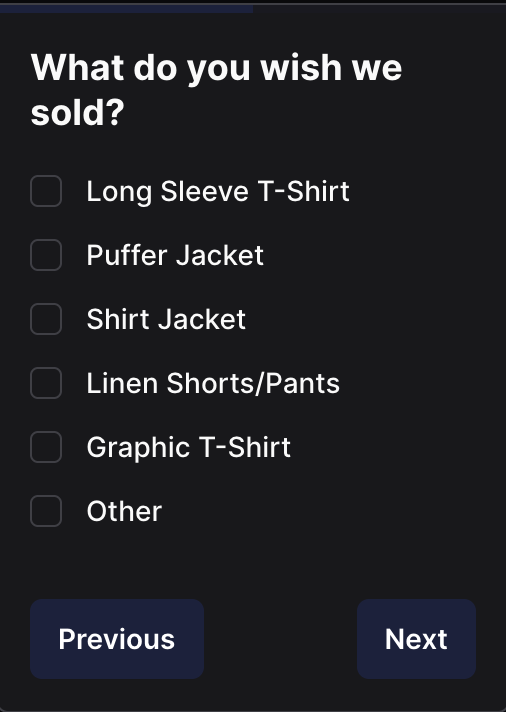
The result was stronger engagement and sales than a standard launch would have produced, because the communication felt personal. The data told them who to talk to. They moved fast.
That’s the standard for new product survey questions: every answer should connect to a decision.
Survey questions to ask about a product (user experience)
13. How easy was it to use this product for the first time?
14. Did you need any additional information to get the most out of this product?
15. How does this product fit into your existing routine?
16. Was the packaging what you expected?
User experience questions are particularly useful for brands in health, wellness, and food categories where onboarding, the first time a customer actually uses the product, determines whether they repurchase. If a meaningful share of customers say they needed more guidance, that’s a product page gap and potentially a packaging fix.
Product satisfaction survey questions
17. On a scale of 0 to 10, how likely are you to recommend this product to a friend?
18. What’s the main reason for your score?
NPS at the product level is underused. Most brands track NPS for the brand overall and miss the product-level signal. A product with a brand-wide NPS of 55 can still have individual SKUs sitting at 30. You won’t see that split in a blended number.
Product market fit survey questions
19. How disappointed would you be if this product were no longer available?
20. Who else do you think would benefit from this product?
Question 19 is the Sean Ellis product-market fit question, adapted for ecommerce. If more than 40% of respondents say “very disappointed,” you have a strong product-market fit. Below that threshold, something in the product or positioning needs work before you scale spend behind it.
Question 20 surfaces word-of-mouth potential and helps you understand how customers think about your audience, which is often more accurate than how your team does.
Tips for crafting effective survey questions
Keep questions clear and concise
Every question should have one job. “How would you rate the quality and packaging of this product?” is two questions. Split them. The more a question asks, the less useful the answer.
Multiple choice outperforms open-ended as a lead question every time. Customers who might abandon a blank text field will answer a four-option multiple-choice question. Use open-ended as a follow-up, not an opener.
Incorporate open-ended questions strategically
Open-ended questions produce the qualitative signal that helps you understand the why behind the numbers. But they work best in second position, after a rating or multiple choice question has already gotten the customer engaged.
Beekman 1802, the skincare brand sells seasonal gift bundles that spike in Q4, and their team had always assumed customers were gifting the sets whole, box and all. An open-ended post-purchase survey question proved otherwise.
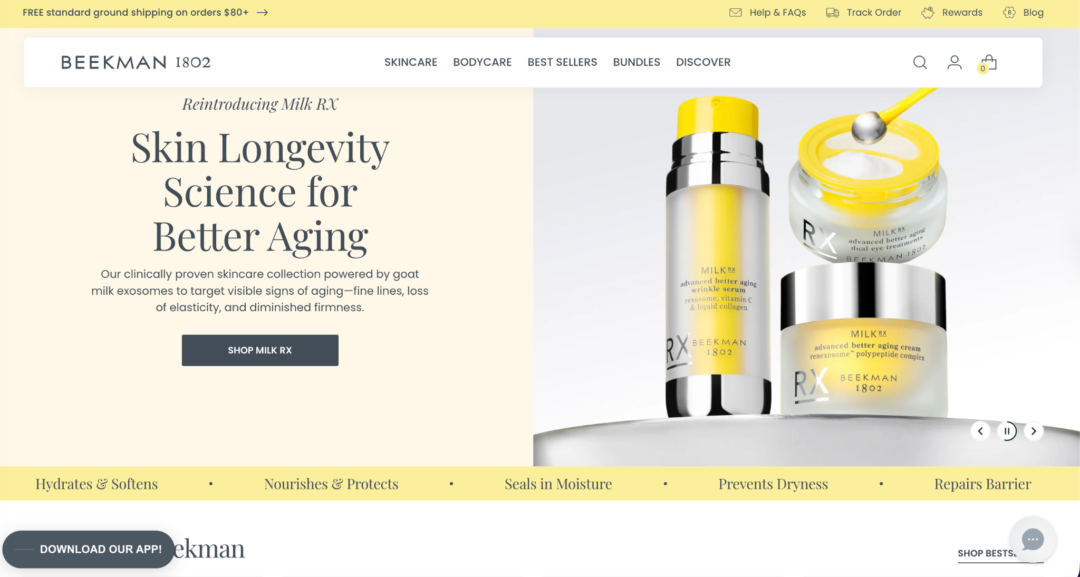
A significant share of customers were actually breaking the bundles apart to buy for multiple people at once. That one insight reshaped how Beekman structured their gift sets going into the holiday season, and gave them a cleaner read on what customers actually valued versus what the packaging team assumed they did.
Look for recurring language in open-ended responses, not one-off comments. If five customers in a week independently mention they weren’t sure about sizing, that’s not anecdotal. It’s a product page fix.
Avoid leading questions
“How much did you enjoy this product?” assumes the customer enjoyed it. “How would you describe your experience with this product?” doesn’t. The framing of a question shapes the answer you get back, and leading questions produce responses that confirm what you wanted to hear rather than what customers actually think.
What to do with the data
Collecting survey responses is step one. Most brands underinvest in what comes next.
Sort your product feedback by customer type. First-time buyers and repeat customers have different baselines and different motivations. Treating their responses as the same population hides the patterns that matter most. The same is true by demographic: what a 25-year-old first-time buyer flags is often different from what a 45-year-old repeat purchaser notices.
Track customer satisfaction score over time. A single NPS snapshot tells you where you are. Monthly tracking tells you whether product changes, reformulations, or packaging updates are actually working.
Act on the recurring themes fast. The most common mistake is letting product feedback sit in a dashboard while the product page it should be improving stays unchanged. If a consistent share of customers flags a specific friction point, that’s a fix, not a finding. In-depth analysis of your survey results is where the real value is, not in the collection itself.
Improving retention often starts here too. The customers most likely to churn are often the ones whose feedback went unacknowledged. When you close the loop, and actually fix the thing they flagged, you give them a reason to stay.
And if you’re running surveys through KnoCommerce, responses sync to customer profiles in real-time. A customer who flags a product issue can be routed to a follow-up flow. A customer who rates a product highly can be surfaced for a referral ask or a review request. The survey stops being a research exercise and starts being infrastructure.
The data is already there
Your customers have opinions about your products. Whether the quality matched the pricing, whether the sizing ran true, whether they’d buy it again. Most of that never gets captured because no one asked.
Product surveys are how you close that gap. They give you a consistent signal across your catalog, a baseline to measure against when you make changes, and the kind of direct feedback that tells you what to fix before it shows up in your return rate.
The brands getting the most out of product surveys aren’t running them once. They’re asking the same core specific questions across every launch, tracking how answers shift after reformulations or packaging changes, and using what they learn to optimize the next decision. The survey stops being a one-off research exercise and starts being infrastructure.
Pick your most important product. Ask the question you most need answered. See what comes back.
If you’re not sure where to start, the KnoCommerce question bank has 200+ survey question examples broken down by vertical, so you can filter to what’s actually relevant to your brand.
If you’re not sure where to start, the KnoCommerce question bank has 200+ survey question examples broken down by vertical, so you can filter to what’s actually relevant to your brand.