Most brands obsess over the NPS question itself. They tweak the wording. They debate the scale. They argue about whether to add a follow-up.
Then they send it from a single email flow, three weeks after purchase, to every customer on the list, and wonder why response rates are hovering somewhere around sad.
NPS distribution is a key metric for measuring customer loyalty and sentiment, but where and when you send your NPS survey matters just as much as the single question itself. A strong NPS distribution strategy factors in your channels, timing, and segmentation to deliver reliable data across your brand.
Why NPS distribution matters
Net Promoter Score measures customer loyalty on a deep level with one simple question: “How likely are you to recommend this company or product?”
Respondents sort into three groups: promoters, passives, and detractors. Subtract the percentage of detractors from the percentage of promoters and you get your NPS score.
That question matters because it measures identity. It forces a customer to consider whether they would actually put their name behind your brand. KnoCommerce launched the first NPS tool built for top ecommerce brands for this reason, linking customer feedback to revenue, lifetime value, and customer retention.
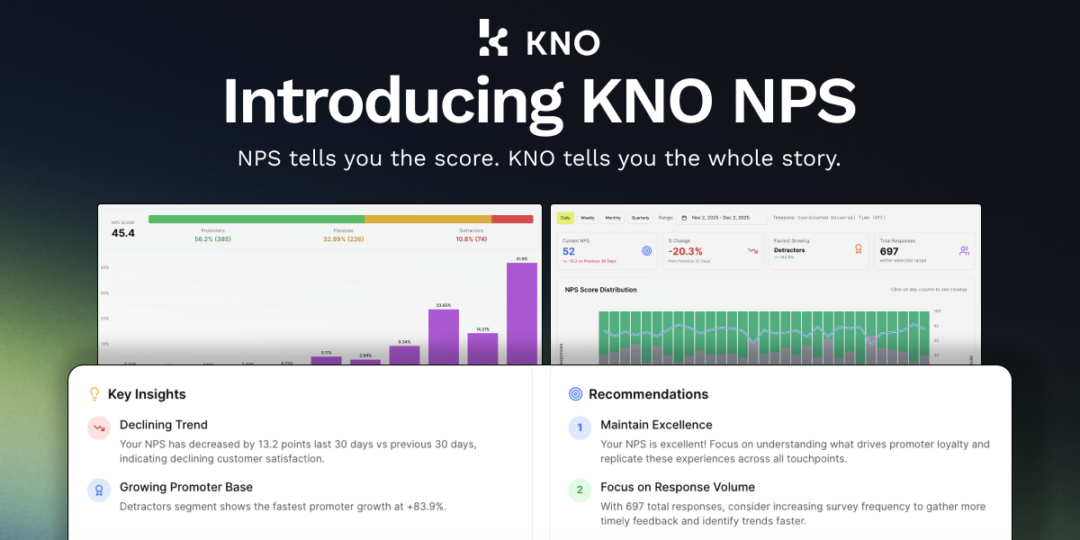
While most brands spend time perfecting the question, the most successful ecommerce brands spend time perfecting the strategy of where to show it. Having an NPS distribution strategy matters because it can be the difference between whether your customers actually answer it.
What is an NPS distribution strategy?
You need an NPS distribution strategy if you want your NPS results to be effective and valuable, rather than a vanity metric sitting in a dashboard nobody opens.
NPS matters for ecommerce brands because it consistently predicts LTV more accurately than any single conversion metric. The right strategy and the right follow-up NPS survey questions can unlock actionable insights that lead to revenue growth, retention, referral activity, and eventually higher customer lifetime value.
An NPS distribution strategy strategically combines three things:
- Channels. Where your customer base actually is. Some combination of email, on-site surveys, SMS, link-based, and customer support.
- Timing. Reaching the right customers at key touchpoints in the customer journey, whether that’s post-purchase, after a repeat order, or after a support interaction.
- Segmentation. Delivering NPS surveys to the right segments with the right context, so the qualitative feedback you collect is actually useful.
When those three pieces work together, NPS stops being a number and starts being a system.
Core channels for NPS distribution
A key part of your NPS distribution is the channels you’ll use to reach customers. Where you place your NPS surveys directly affects response rates, data quality, and the insights you can pull from them.
Email remains a key channel for NPS survey distribution because it’s easy to automate and easy to send after a key purchase event.
You’ll see better response rates through email when it’s strategically timed after key moments like post-purchase, a repeat purchase milestone, or a re-engagement campaign. When choosing email for your NPS survey, keep it simple with one core question and embed it directly within the email body. The goal is to reduce friction and capture high-quality responses from existing customers without forcing them to click through to another page.
On-site NPS surveys
On-site surveys capture customer feedback in the moment from customers on a specific page, such as a blog, pop-up, post-purchase page, or subscription page.
These can be effective because they catch users when they’re most highly engaged and capture customer sentiment during a real interaction in real-time. Ecommerce brands often place them on the post-purchase page immediately after checkout, or on the customer dashboard after a repeat purchase. The key is to keep the NPS survey simple and relevant to what the customer just clicked or viewed. The action they took right before seeing the survey should match the survey question you’re asking.
Link-based surveys
Link-based surveys are NPS surveys delivered via a link that takes the customer to a page to answer the questions.
Common placements include SMS campaigns, which can be further segmented to reach a specific set of customers at a key moment. Ecommerce brands can also deploy link-based surveys via QR codes printed on product packaging, delivery boxes, and in-store signage. Other distribution points include community channels run directly by your brand, or forums and groups your team monitors closely, such as Slack, Reddit, and Discord.
Customer support and live chat
Customer support and live chat can be a strong channel for NPS distribution because they follow up immediately after a customer is either most satisfied or has just had a problem resolved. That timing makes them valuable for collecting honest sentiment.
After a live chat conversation, ask the customer if they can answer one quick question and follow up immediately with a link or email. The feeling is sharp, the customer experience is fresh, and the response rate reflects that.
Social and community channels
Social media and community channels aren’t a traditional way to distribute or collect NPS responses, but they’re quickly becoming a place where brands can track sentiment and broad feedback on product, customer experience, and overall brand health.
Each social media channel can be a good place for a quick pulse check on something specific or broad. Responses vary depending on the size of your following and engagement levels, and it can be harder to tie responses to specific customer segments. Still, it’s a great channel for quick feedback through polls, comments, DMs, and private communities, and a useful proxy for word-of-mouth and advocacy in the wild.
SMS and mobile
SMS campaigns can distribute NPS survey questions by directing customers to a link-based survey or by letting customers send a quick response back directly.
The key is to keep these campaigns concise and pair them with a timing strategy so your customers have context and are at a moment of high engagement with your brand.
Marleylilly, a personalization brand, uses survey responses to refine its marketing strategies through win-back SMS campaigns targeting customers who haven’t purchased in a while. The survey is dynamically adjusted based on responses, which allows Marleylilly to engage with customers in a highly targeted and personalized way.

Timing strategy
Timing is key to getting responses and high-quality NPS data from your customers. Without the right timing, even the right channel can lead to no responses. The goal is to align your NPS survey with key customer journey moments:
- Immediately post-purchase
- After a customer service interaction
- After product delivery
- At key milestones for the customer (first, fifth, tenth purchase)
With timing, you also want to avoid sending too many NPS surveys, or sending them at random times that give the customer no context. Timing depends on your industry, your price point, and your ecommerce store.
If you’re working in CPG or digital goods, we recommend sending 7 to 14 days after the purchase event. Anything beyond that and customers have probably forgotten what they bought. For high-end products with a longer consideration and use cycle, we recommend 45 to 60 days.
With the right strategy in place, NPS questions and follow-up surveys become a strategic lens into your customer relationships.
Combining channels
The most effective NPS programs don’t rely on a single channel. They use a combination of channels to reach customers and gather data you can actually use.
Prismfly, an ecommerce optimization agency, used NPS responses and post-purchase data to understand what influenced real buying decisions for their client CrunchLabs. The team evaluated recurring themes from customer feedback and mapped them to known conversion levers across trust, clarity, and incentive strength. That work fed directly into a homepage experiment that lifted conversion rate by 4.7% and revenue by 10.2%.
That kind of outcome only happens when NPS data is rich enough to interrogate, and that richness comes from layering channels.
Segmentation
A key part of getting high-quality responses is segmenting your NPS surveys. Not every customer should receive the same NPS survey, and not all at the same time.
Segment based on:
- New vs. returning or loyal customers
- Acquisition channels
- Purchase milestones
- High vs. low lifetime value customers
- Demographics and product category
Segmentation is also what lets your follow-up ecommerce survey questions and your NPS question formatting do real work. A first-time promoter needs a different follow-up than a fifth-purchase detractor, and only segmentation gets you that level of precision in your survey design.
Mistakes to avoid in your NPS distribution strategy
A few patterns quietly kill NPS programs before they get useful:
- Packing your NPS survey with too many questions. Overload causes drop-offs and poor response quality.
- Relying solely on a post-purchase email survey. The point of an NPS distribution strategy is to uncover what customers truly think across moments and channels. One channel gives you one slice and tells you very little about churn risk.
- Ignoring timing and segmentation. Without both, you’re collecting noise.
NPS is a system that can drive real value for your brand
NPS can uncover real insights and qualitative data for your ecommerce brand, but only if the distribution strategy behind it is built to drive insights, not just collect scores.
Channels, timing, and segmentation are what turn one simple question into a steady feed of intelligence about your customers, your customer satisfaction levels, and the experience moments that drive loyalty or churn. Get those three working together and NPS starts looking less like a number and more like a roadmap.
Ready to build an NPS program that actually drives decisions? Book a demo to see how KnoCommerce powers NPS for top ecommerce brands.