
Marketers and ecommerce teams have access to more data than ever, yet proving what drove revenue and where attribution came from is harder than ever.
Marketing attribution has become more difficult to pinpoint, especially if you’re looking for one single source of truth. The rise of AI as a new attribution channel, new social platforms, privacy regulations, and more have introduced blind spots when it comes to attribution.
Marketing attribution in ecommerce in 2026 isn’t about finding the perfect tool or digging deeper into one set of analytics. It’s about building a system that combines multiple sets of data such as zero and first-party data, customer feedback, NPS surveys, and post-purchase survey tools.
Marketing attribution is broken in 2026
Customer journey behavior, privacy rules, multi-channel discovery, and the rise of AI in how customers discover and purchase from brands have all contributed to a fragmented attribution picture.
Marketing attribution is broken in 2026 because there’s no longer a linear path that ties a purchase to one direct click. Last-click attribution has lost most of its usefulness, and traditional attribution models weren’t built for the multi-device, multi-platform reality ecommerce brands are operating in. Third-party cookies are gone or going, and the endless privacy changes have made attribution hard to measure, even when your site visitors are on your site taking action. It’s estimated that Google Analytics 4 underreports traffic by 20% for sites with cookie consent banners.
AI has completely shifted how shoppers discover and purchase brands. AI has become a new acquisition channel and an engine of product recommendations. Industry reporting shows AI-driven traffic to U.S. retailers surged more than 800% year over year during Black Friday, and channel fragmentation keeps increasing as customers browse and shop across devices and platforms.
Challenge 1: Fragmented customer journeys across channels
Every customer journey is different across your site. Even if attribution is coming from one channel versus another, there are variables within that channel that shape how customers actually landed there.
Maybe a customer saw an Instagram post and, days later, went directly to your site. Maybe a different customer saw the same Instagram post, got served a Meta ad, and after several impressions, finally converted. Each journey was different, even if both started on the same channel.
Your customers move through different platforms, channels, and devices, which means traditional attribution tools and your own analytics will struggle to connect all these touchpoints. Top-of-funnel channels become undervalued and your measurement into what’s actually working becomes inaccurate. Multiple touchpoints influence a decision long before a final click happens, often shaping outcomes like average order value, LTV, and post-purchase engagement.
How to overcome this challenge: Build unified customer profiles you can actually layer data into. Start with what motivates your customers and what their behaviors look like, then add customer feedback surveys on top. Strategic post-purchase surveys let customers self-report where they discovered you, which gives you a clear view of attribution your platforms can’t see on their own. This is where multi-touch attribution earns its place, because a single survey response can fill in the gaps between first-touch, mid-funnel, and the final conversion.
Challenge 2: Attribution gaps across platforms and devices
A traditional customer journey in 2026 might look like discovering a brand on TikTok on a phone. Later, that same customer is served a retargeting ad on Instagram. A few days after that, they search for the brand and browse on a laptop. Meanwhile, they get a piece of physical mail. Weeks later, they purchase the product in-store.
In that scenario, your attribution and analytics see the conversion initiation happening at different points. One customer turns into multiple identities under attribution.
A modern ecommerce customer journey doesn’t happen on one device or platform anymore. In a true omnichannel world, customers move seamlessly between mobile devices, laptops, emails, social platforms, AI platforms, live-selling, and in-person retail. To the consumer, each touchpoint is one single experience. From an ecommerce analytics perspective, attribution is disconnected.
The challenge becomes incomplete conversions paths, less accurate retargeting strategies, and channels that appear ineffective when they aren’t. Brands relying on first-touch attribution or last-touch attribution alone end up with two different answers to the same question.
How to overcome this challenge:
- Build attribution surveys that connect customer interactions with responses they voluntarily give your brand. Invite customers to share where they heard about you through a custom post-purchase survey.
- Encourage logged-in experiences through loyalty programs and subscription accounts so you can stitch identities together across devices.
- Build strong customer profiles with survey responses and NPS data to get the full picture of how customers behave and what motivates them.
- Layer in incrementality testing where you can. Geo holdouts and channel-level pauses help confirm what your surveys are already telling you about which channels actually move the needle.
Apparel brand BYLT leans on post-purchase data not only to make decisions but to validate that their campaigns and budget are being spent wisely. Their KnoCommerce surveys offer a 10% off incentive in exchange for a few questions. Low lift for the customer, real signal for the operator.

As the BYLT team puts it, simple questions like “How did you hear about us?” and “What’s your favorite product?” turn into tangible, actionable takeaways that fuel smarter decisions across product design, marketing, and finance.
Challenge 3: Dark traffic and AI
Having fragmented attribution sources and traffic is one piece of the challenge. The other half comes from dark traffic, the traffic that appears to be direct traffic but actually comes from a source you aren’t tracking. AI platforms that direct shoppers to your site, social media app links embedded in DMs or threads, and zero-click search all fall into this bucket.
That makes it easy to give credit to a source that looks like it’s driving impact when the real driver is hidden. AI has become a major source of dark traffic as more users head to AI platforms for product recommendations. With Shopify’s integration, customers can purchase without leaving the AI platform at all.
KnoCommerce predicts that AI-driven discovery will account for 5 to 10% of brand discovery within the next 12 to 18 months. Our data shows AI and ChatGPT in a clear hypergrowth stage, with 25 to 30% month-over-month growth. According to Search Engine Journal, dark traffic can account for up to a 60% discrepancy, which makes it nearly impossible to pinpoint where attribution actually came from.
As they describe it, dark traffic arrives at your website from a URL that’s difficult to track, and typically gets lumped under direct traffic in analytics programs because it lacks a referrer string.
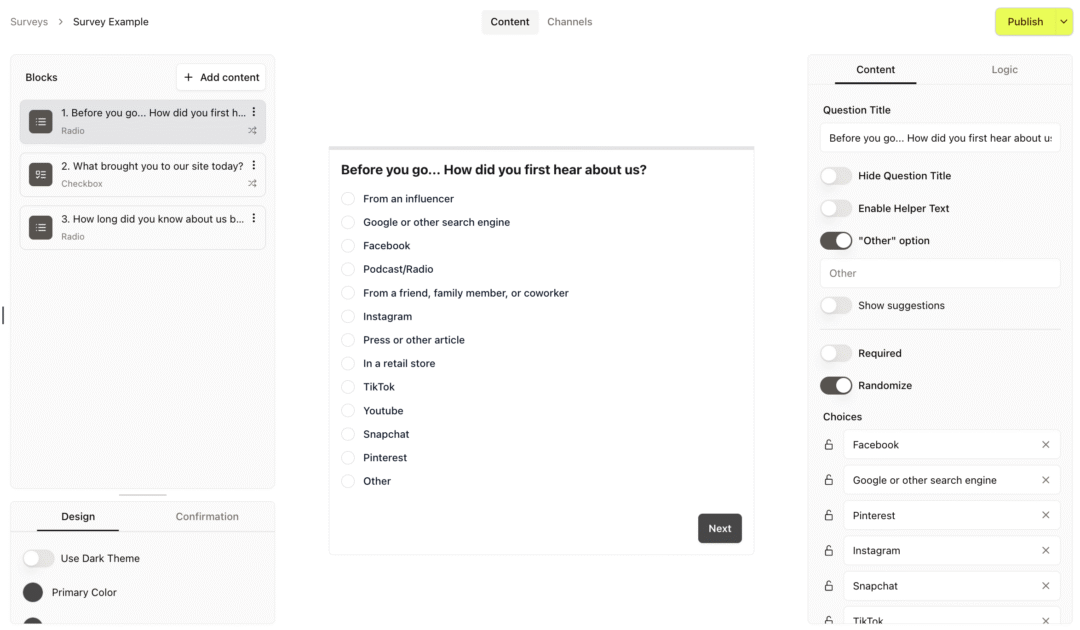
How to overcome this challenge: Add a post-purchase survey flow that captures responses directly from your customers. KnoCommerce lets you build flexible questions that collect whatever data you need, from demographics to purchase motivation to birthday questions. These surveys help you track branded search lifts and uncover the invisible traffic that shows which channel is actually driving conversions. Deploy in minutes and start monitoring patterns with all the data in one place.
Challenge 4: Privacy and cookies
For years, cookies were the backbone of marketing attribution and the way to measure how customers moved from an ad click to a conversion. Cookies and other third-party tracking made it easy to connect a customer’s touchpoints to attribution, and platforms like Google Ads could close the loop on most paid campaigns with minimal manual work.
That’s no longer how it works. Privacy expectations and the information customers willingly give brands have shifted in the last few years. GDPR, CCPA, and the broader wave of privacy regulations mean you now need consent on what you can track, and even then, only necessary cookies are placed, with some states and countries enforcing stricter rules than others.
How to overcome this challenge:
- Drive zero and first-party data collection through NPS and post-purchase surveys sent across email, SMS, post-purchase pages, link-based formats, and social media.
- Give customers a reason to build a profile with you through loyalty programs, subscription accounts, customer accounts for faster checkout, and personalized recommendations.
- Connect survey responses to your CRM so the data you collect actually moves through the rest of your stack instead of sitting in a dashboard.
Skincare brand Beekman 1802 wanted to understand their customer better ahead of a Q4 campaign. With just two questions, the team established a baseline of customer preferences and built their seasonal strategy around the results.

They asked, “How do you plan on gifting?” and “If your gift for someone else came in a Beekman 1802 box, do you plan to gift the entire box to someone or give separate items to different people?” Two questions, one campaign foundation.
Challenge 5: Siloed data
More tools can mean more data silos that disconnect from your customer’s overall profile. Once you have a strategy to uncover data and build customer profiles, the next challenge in attribution becomes visibility.
This is especially true if you’re interacting with customers across multiple platforms, tools, and channels. On their own, each of those tools can drive insights. But the whole picture stays siloed when the data lives in different places. When customer data is siloed, measuring attribution and impact gets harder because the data has gaps. You end up measuring duplicate site visitors, fragmenting customer identities, and producing performance metrics that aren’t reliable. ROI and ROAS numbers start contradicting each other across reports because each tool is working off a different slice of the truth.
How to overcome this challenge: Create a system where your tools connect, or build toward a single source of truth for customer profiles. Connect your tools through integrations so the data stays in one place.
The KnoCommerce and Klaviyo integration is a good example of what that looks like in practice. The integration makes it easy to publish NPS campaigns that communicate directly with Klaviyo and tie results to your customer data.
We believe in making data actionable, which is why we’ve built the ability to push survey status and survey responses into Klaviyo. Instead of manually building surveys and campaigns side by side, the integration gives ecommerce brands a system that visualizes data in one place.
Challenge 6: Measuring one aspect of the customer funnel
One of the biggest challenges of marketing attribution is choosing to focus on one part of the funnel and giving credit to the last click. Top-of-funnel campaigns are usually the ones that don’t get credit, especially during large awareness pushes and long sales cycles. That could be an influencer campaign, a podcast, direct mail, or a TV spot.
Top-of-funnel content is designed to drive demand and brand awareness, yet rarely gets attributed to a conversion. A customer might see a commercial, then two weeks later see the brand on social and follow them, then a week after that sign up for an email list. After weeks of nurturing emails, that customer finally makes a purchase. The attribution goes to email, when in reality the journey started with the commercial.
This is exactly where multi-touch attribution models outperform single-touch logic. Linear attribution spreads credit evenly across every touchpoint, time decay attribution weights recent interactions more heavily, and data-driven attribution uses machine learning to assign credit based on which touchpoints actually correlate with conversions. None of them are perfect on their own, but layered with post-purchase surveys and NPS questions, you get a much clearer picture of which channel actually influenced the discovery and the purchase. Some brands also bring in marketing mix modeling (or MMM) for the channels that don’t generate click data at all.
How to overcome this challenge: Drive strategic questions that get customers to willingly share information you can use to build profiles and measure lifts. Analyze your data and trends for signals that a customer came from a top-of-funnel campaign, like increases in traffic, changes in conversion rates, or new customer acquisition patterns that line up with a launch.
Your surveys are only as strong as when you send them. Send during high-engagement windows, when customers are already interacting with your brand through email, app activity, or a recent purchase. Keep it frictionless with embedded email surveys, simple link-based formats, and single-click responses to drive the strongest participation.
Graza is a good example here. The olive oil brand has grown into a nationwide grocery presence, and a lot of that growth came from influencer campaigns and social media. While the website often received credit for the conversion, the Graza team knew those top-of-funnel awareness campaigns were doing the real work of discovery. One post-purchase question let them see where customers actually first encountered the brand, which gave them attribution for the awareness work that platform reporting kept missing.
Challenge 7: Treating attribution as a report
The valuable part of overcoming marketing attribution challenges is building strategies that connect data and turn it into a growth strategy, not just an analytics report that sits there.
Ecommerce teams can easily get comfortable viewing attribution reports as surface-level vanity metrics instead of extracting insights that will actually help the brand grow. Your insights should drive action, and your KPI mix should reflect the channels and behaviors that move the business, not just the ones that are easiest to measure.
How to overcome this challenge:
- Combine your data with strategic follow-up surveys and NPS questions to understand what motivates customers beyond the score itself.
- Categorize responses by the type of feedback you receive (product, customer service, overall experience) so you can prioritize which category to tackle first.
- Look for patterns across all your customer feedback. Which problems keep surfacing? Which pain points come up repeatedly? Which features are customers loving?
- Visualize the data. With your KnoCommerce account, you can visualize customer responses in multiple ways so the patterns are obvious instead of buried in a spreadsheet.
The future of customer attribution
The future of attribution is shifting from a linear path to a more complex network. It isn’t disappearing. It’s evolving into a system that allows deeper analysis and pushes ecommerce teams to really think about their campaigns and what actually drove customer behavior.
Having access to more data than ever means brand marketers need to dive deeper into customer behavior. These challenges are exactly why customer feedback and behavior data matter so much for growth.
Want to see how this works for your brand? Book a demo and we’ll show you how post-purchase surveys, NPS, and your existing stack come together inside KnoCommerce.