
Reviews are the closest thing retail has to a shortcut. A shopper who skips your product description will still scan the star rating and read a few recent reviews before deciding.
The Spiegel Research Center at Northwestern found that a product with five reviews is 270% more likely to be purchased than the same product with none, and for higher-priced items that lift reaches 380%. So the question isn’t whether reviews matter.
The problem is what happens after you accept that they do. Most retail teams collect a fraction of the reviews they could, display them where nobody looks, and pick a platform based on the monthly price instead of what it does for conversion. This guide breaks down the best customer review management platforms for retail, where each one fits, and how to match the choice to your stage. It also covers the part most roundups skip: getting more reviews worth managing in the first place.
What a customer review management platform actually does
A review widget shows reviews. A customer review management platform runs the whole loop, from the request that collects a review to the display that converts a shopper to the reuse that stretches that content across your marketing. Here’s what that includes:
- Collection. Automated post-purchase requests that gather product reviews, site reviews, photos, and video, with reminder logic and multiple channels so you actually get responses
- Moderation and publishing. Control over what displays without hand-approving every entry
- Display. Star ratings and review content on product pages, collection pages, and the homepage, loading fast and working on mobile
- Distribution. Syndication to Google Shopping and Google Ads, where Seller Ratings lift ad click-through rate by around 10% on average, plus, for omnichannel brands, syndication to retail-partner and marketplace pages
- Reuse. Feeding review language and imagery back into ads, email, and landing pages as social proof
If a tool only does the middle part, displaying reviews you somehow collected on your own, it’s a widget. The platforms below manage the full cycle.
What to look for when choosing a customer review management platform
Set your criteria before you compare prices. The cheapest tool that under-collects will cost you more in lost reviews than its sticker price ever saves you, and the gap shows up directly in conversion. PowerReviews found a 91.4% lift in conversion when shoppers interact with customer photos and videos on a product page, with the rate climbing from 3.4% to 6.6%, and 91% of consumers say they’re more likely to buy a product whose reviews feature photos and video alongside text. Volume matters too, but not endlessly, since the Spiegel research found the first five reviews carry the biggest conversion impact. A platform’s real job is to collect that content, surface the right pieces of it, and reuse it, not just store it. Here’s what to weigh against that job.
Request and response rate
- Automated post-purchase requests with timing you can control, so the ask lands after the product has actually been used
- Reminder logic and channel flexibility, since pairing email with SMS lifts response
- Photo and video capture built into the request, since visual reviews carry more weight than text alone
Display and conversion
- Widgets that load fast and don’t drag down page speed
- Star ratings on collection pages, not just product pages
- Q&A, review highlights, and filtering, so a shopper finds the review that answers their specific objection
Distribution and reuse
- Google Seller Ratings and product ratings syndication, which feeds your ad Quality Score and can lower cost-per-click over time
- Export tools that turn review language into ad copy and product-page content
- Retail-partner syndication if you sell wholesale or through marketplaces
Integrations and stack fit
- Native Shopify support and a clean install
- Connections to your email platform, loyalty tool, and helpdesk
- API access for custom or headless builds
The best customer review management platforms for retail
There’s no single winner here. The right pick depends on your catalog size, your budget, and how much of a marketing suite you want in one place. Here’s where each option fits.
Yotpo
Best for: larger and enterprise retail brands that want reviews, loyalty, SMS, and UGC under one roof.
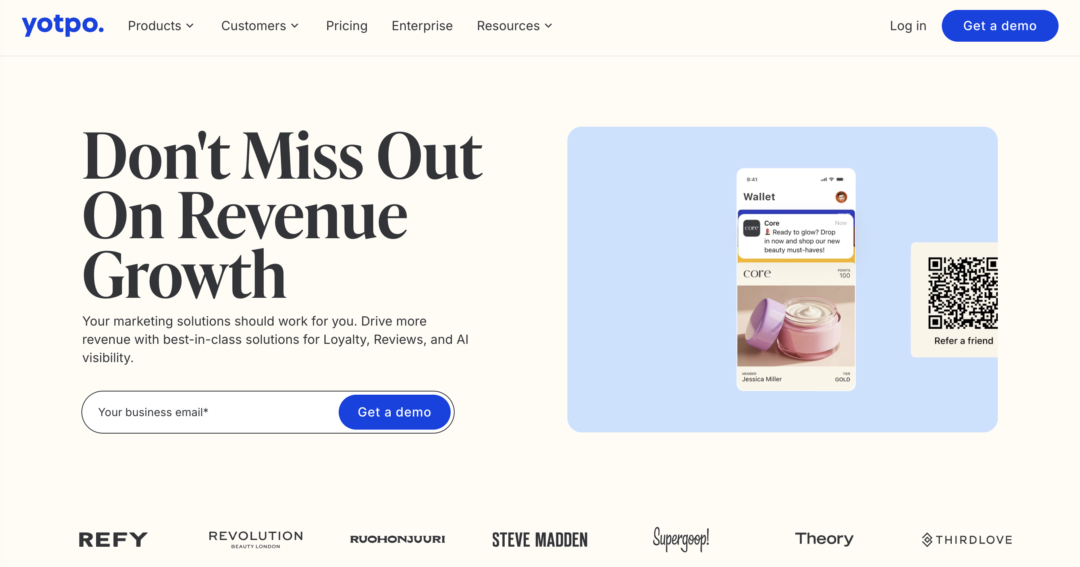
Yotpo’s strength is breadth. Mature integrations, strong syndication, and a full suite of adjacent tools make it a fit for brands that want to consolidate. The trade-off is that cost and complexity climb fast, often past what a growth-stage team actually needs.
Stamped
Best for: mid-market brands that want reviews, ratings, loyalty, and NPS in one connected platform.
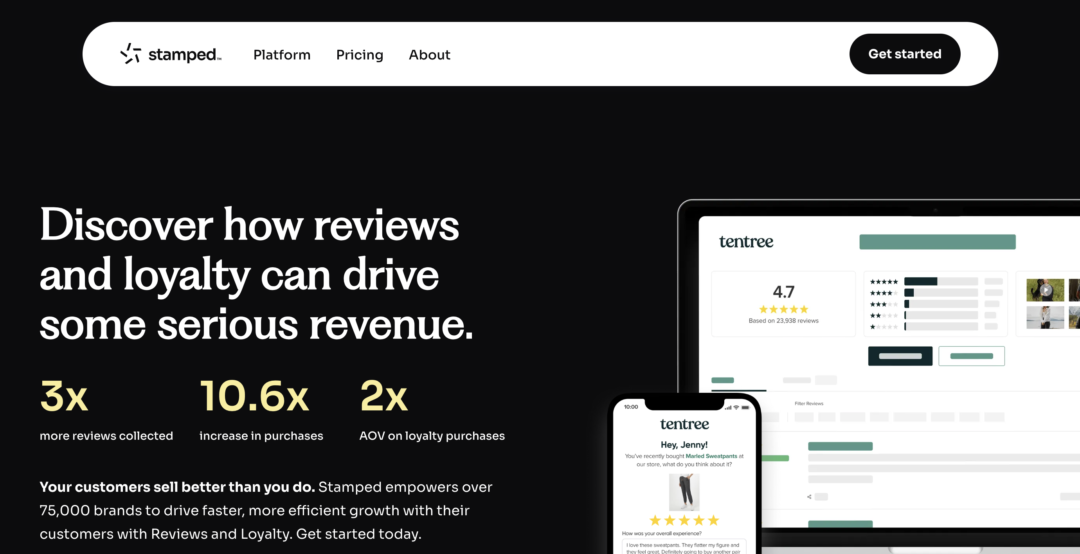
Stamped brings reviews, product ratings, loyalty, and NPS together, which makes it a strong fit for brands that want their social proof and retention data working from the same place instead of scattered across tools. Photo and video collection is solid, the display options are flexible, and the loyalty side gives you a reason to keep customers engaged after the first review lands. For a mid-market brand consolidating its stack, it covers a lot of ground at a reasonable price.
Okendo
Best for: growth-stage Shopify DTC brands.
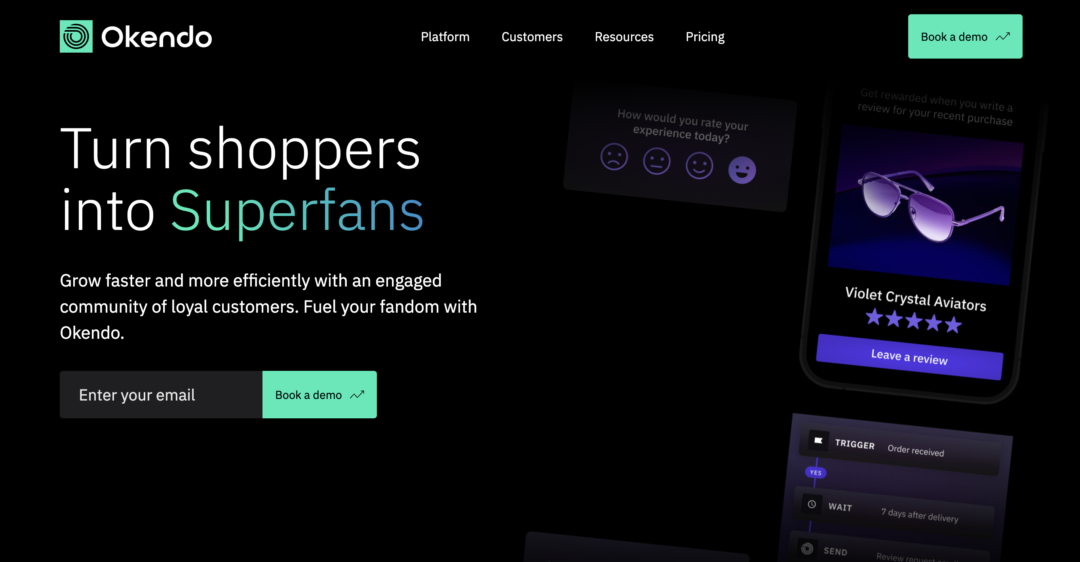
Okendo collects rich review attributes and strong visual content, and it sits inside an ecosystem that includes surveys, referrals, and loyalty. It’s priced above the entry-level tools, but for a brand scaling on Shopify it hits a useful middle ground.
Junip
Best for: growing Shopify brands that want a clean, modern setup without enterprise overhead.
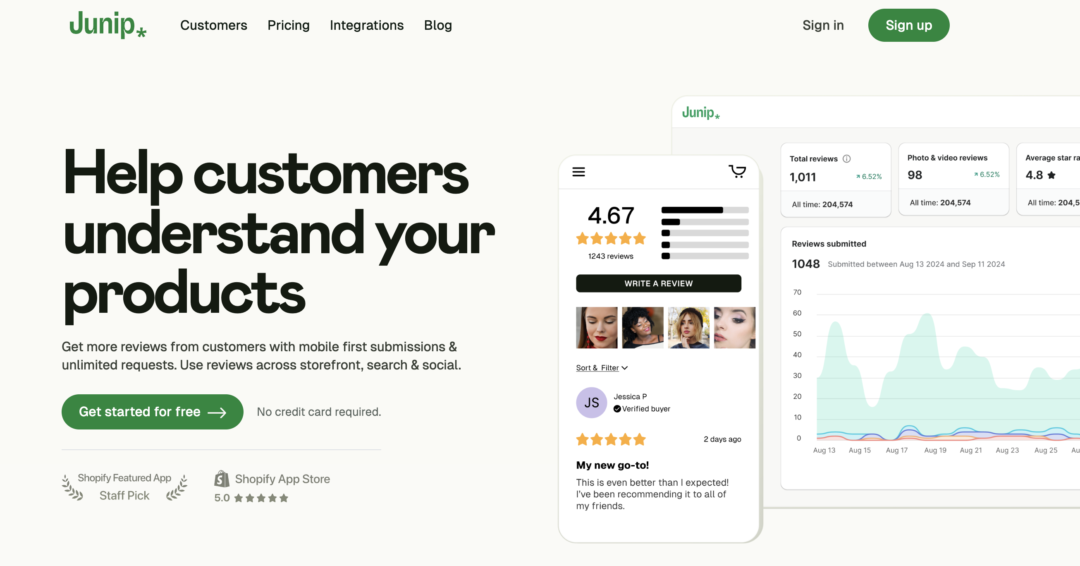
Junip installs fast, ships sensible defaults, and tends to pull strong response rates. Feature depth is lighter than the full suites, which is exactly the point for teams that want reviews done well without a lot of configuration.
Loox
Best for: small and mid-size Shopify stores where visual proof is the whole point.
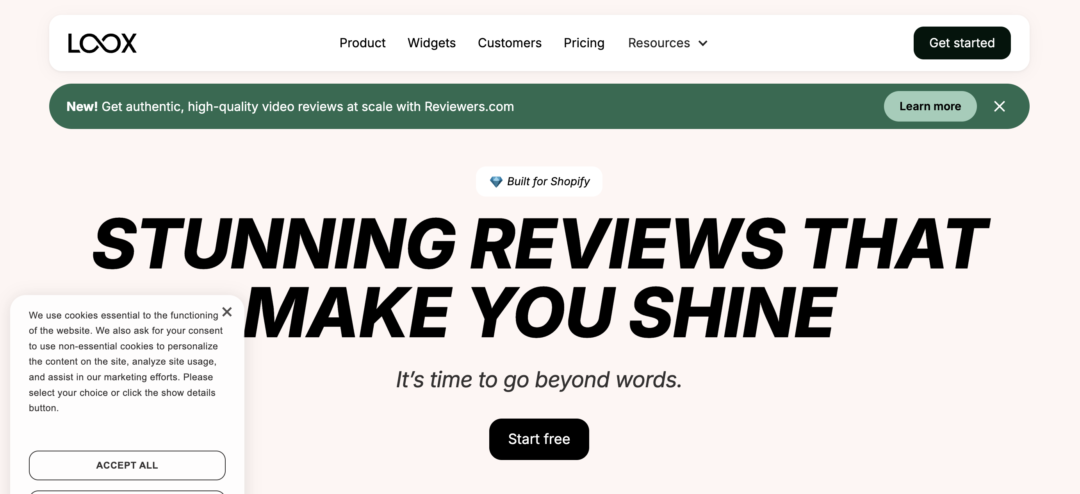
Loox is built around photo and video reviews, with referral features layered in, at an approachable price. It’s less suited to complex catalogs or heavy omnichannel syndication, but for a visually driven store it does its core job well.
Judge.me
Best for: budget-conscious and early-stage brands.

Judge.me offers a generous free tier and one of the better feature-to-price ratios on Shopify, which is why it’s so widely installed. Display and reporting are more basic than the premium tools, but the fundamentals are covered.
Trustpilot
Best for: brand-level and site-level trust rather than product reviews.

Trustpilot carries recognized third-party credibility, which makes it useful for reputation and for trust signals in paid social and search. Because it focuses on company reviews rather than product reviews, most retailers run it alongside a product-review tool rather than instead of one.
Bazaarvoice
Best for: brands selling through major retailers and marketplaces that need ratings syndicated across retail-partner sites.
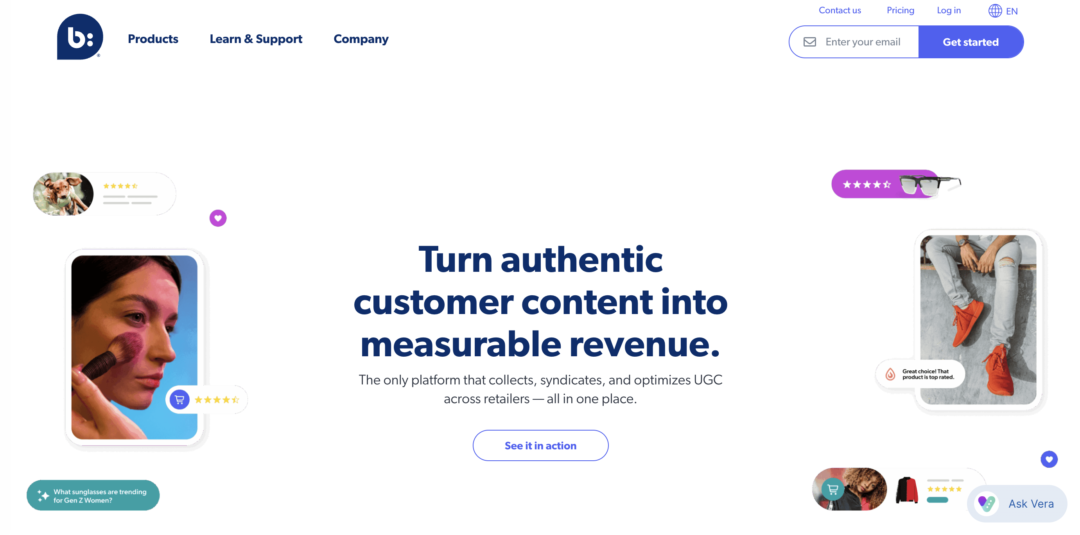
Bazaarvoice is enterprise-grade, with a retail network that reaches well beyond your own store. That reach is the reason to choose it, and the enterprise pricing and setup are the reason it’s overkill for a pure DTC brand.
How to get more reviews worth managing
Here’s the part the platform comparison won’t solve for you. A review management tool can only publish what customers actually send, so collection is the real lever, and this is where survey data does the heavy lifting.
Find your promoters first. An NPS survey surfaces the customers who already want to put their name behind you, and those are your highest-yield review requests. Asking a detractor for a public review is how you end up managing a problem instead of a testimonial.
Ask at the right moment. Request the review after delivery and real use, not on the thank-you page where intent is low and the customer hasn’t touched the product yet. Timing also protects freshness, and freshness matters, because a steady collection cadence keeps recent reviews on the page instead of a wall of year-old ones.
Route by sentiment. Send promoters into review and referral flows, and send detractors to customer support before a bad review ever gets written. A good survey tool does this routing automatically.
Use the post-purchase survey screen as a review prompt. The moment right after a customer answers a survey is one they’re already engaged in, which makes it a natural place to ask for a review or point them toward one.
The payoff shows up when collection and display work together. When Prismfly worked with CrunchLabs, they elevated social proof on the homepage, including a 4.8-star review and a 98.5% customer satisfaction score built on KnoCommerce NPS data, and that change helped drive a 10.2% revenue lift. The reviews did the converting. The survey program is what made those reviews available to elevate in the first place.
The takeaway: your review platform is the display layer, and your survey and NPS program is the supply.
Matching the platform to your stage
- Early stage or tight budget: Judge.me or Loox get reviews live and visual without overspending
- Growth-stage Shopify DTC: Junip or Okendo for response rates and room to grow, or Stamped if you want reviews, loyalty, and NPS in one platform.
- Larger or multi-channel retail: Yotpo for the suite, Bazaarvoice for retail-partner syndication, and Trustpilot alongside either one for brand-level trust
Whatever you land on, budget for collection, not just display. A premium widget sitting on thin review volume still underperforms a modest widget backed by a steady flow of fresh, high-quality reviews.
Choose the platform, then fix the supply
The best customer review management platform for retail is the one that fits your catalog, your budget, and your channel mix. Most teams overthink the tool and under-invest in how reviews get collected, which is backwards. Pick a platform that displays and distributes well, then build the survey and NPS layer that keeps high-quality reviews flowing into it.
That second half is where KnoCommerce fits. KNO helps you find the promoters worth asking, route detractors to support before they write a review, and turn post-purchase feedback into a steady supply of the social proof your review platform exists to display. Book a demo to see how it works.