
Your store analytics tell you what customers bought. A retail customer experience survey tells you why they almost didn’t.
For brands competing across online and offline channels, that distinction matters. Behavior data shows patterns. Direct customer feedback shows intent. And the gap between them is where most retail businesses lose customers they never knew they were losing.
81% of consumers say they’d switch to a different company if they thought it offered a better experience. That’s not a conversion problem. It’s a listening problem.
KnoCommerce helps brands turn customer feedback into the insights that tell you exactly what to do next.
Why customer experience surveys matter
Repeat customers are the engine of any retail business. And the fastest way to lose them is to stop paying attention to what they’re telling you.
Customer satisfaction surveys are a strategic tool for collecting zero-party data information customers give you willingly that tells you where you’re winning and where you’re falling short. For ecommerce brands looking to scale, they need to be part of your post-purchase systems. Not because they’re a nice addition, but because the alternative is making decisions based on incomplete information.
Think about what that actually costs. When a customer has a frustrating experience and leaves without saying anything, you don’t just lose that sale. You lose every future purchase they would have made, and you miss the referrals they would have sent your way. Most brands have no idea how often this is happening because they never asked.
Online retail is growing, but physical stores are far from obsolete. Though U.S. ecommerce sales will account for 29% of all retail purchases, the remaining 71%, roughly $4.4 trillion, will still come from in-store transactions. The brands winning long-term aren’t optimizing for one channel. They’re building omnichannel experiences that hold up everywhere, and using customer data to close the gap between the two.
That starts with asking the right questions.
Types of retail customer experience surveys:
Not every survey serves the same purpose. The type you deploy should depend on what you’re trying to learn and where a customer is in their relationship with your brand.
KnoCommerce supports a wide range of survey experiences with 30+ full survey templates to get you started so you’re not building from scratch every time.
Post-purchase Survey
A post-purchase survey fires right after checkout, when a customer is still engaged and the experience is fresh. Delivered by email or a post-purchase landing page, it captures why someone bought, how they found you, and what influenced their decision to convert.
70% of consumers say bad customer service is enough to send them somewhere else. A post-purchase survey catches the signal before it becomes a cancellation or a one-star review.
Take Loop Earplugs. They built post-purchase surveys to understand customer behavior, refine their marketing campaigns, and shape product development. Their approach was to split the survey by customer type.
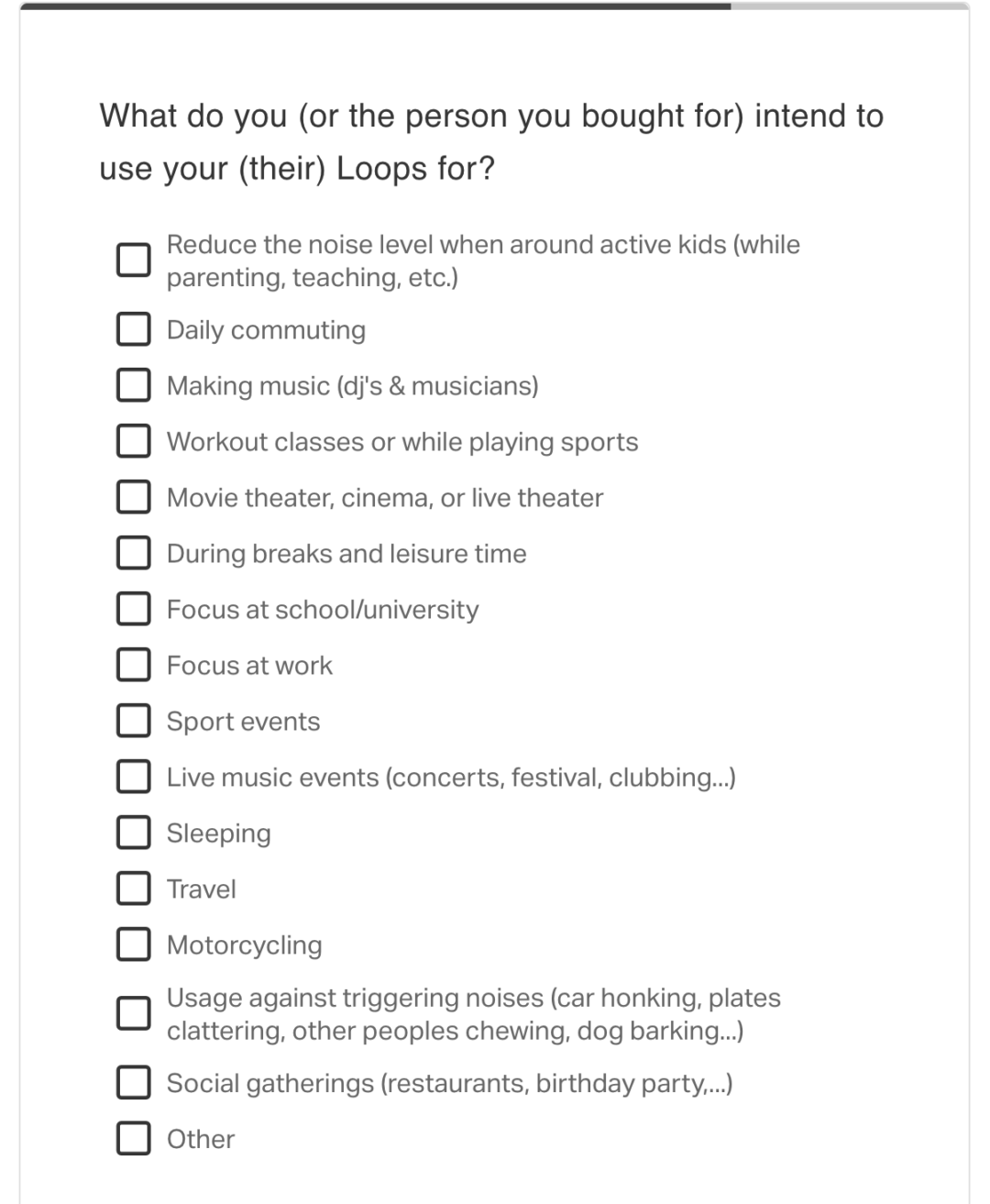
First-time buyers answered questions about brand awareness and initial purchase drivers. Repeat customers answered questions about what kept them coming back. Two audiences, two sets of insights, one system.
Browse the full question bank to build yours.
Attribution Survey
Attribution surveys answer one of the hardest questions in retail:
Where did this customer actually come from?
Last-click attribution misses the full story. A customer might have seen a TikTok ad, searched your brand name a week later, and converted through email. An attribution survey lets them tell you directly which channel moved the needle.
Many brands install KnoCommerce specifically to get a clearer read on customer acquisition and marketing attribution. The data tells you which channels to lean into, which ones to pull back on, and how your online and offline campaigns are actually tying to conversion.
NPS Survey
Net Promoter Score isn’t just a number. It’s a proxy for whether your customers would put their reputation on the line for you.
NPS surveys ask one core question: how likely are you to recommend this brand?
The follow-up questions are where the real insight lives. NPS consistently predicts LTV more accurately than any single conversion metric.
The right strategy tells you who your most loyal customers are, what keeps them coming back, and what’s quietly driving others away.
With the right follow-up questions in place, NPS becomes a strategic lens into product-market fit and customer sentiment.
KnoCommerce lets brands deploy NPS at exactly the right journey moments through Touchpoints, collecting feedback 30 days after an order, upon delivery, or at any other trigger that makes sense for your brand.
Knowing when and how to distribute surveys
Timing drives completion. Send too late and the experience has faded. Most retailers wait anywhere from a few hours to a few days to ask for feedback. Here’s how the main channels break down:
Email is the most common delivery method. Whether a purchase happened online or in-store, a post-purchase email can go out immediately or within a few hours of checkout. Embedded surveys tend to perform best here because customers don’t have to leave their inbox to respond.
SMS works well for shorter interactions. A simple yes/no prompt via text can drive customers to a landing page for a more detailed survey, or capture quick sentiment data on its own.
Touchpoints NPS collects relationship-level feedback at the moments that matter most. Instead of a one-off survey blast, Touchpoints turns feedback into an ongoing conversation, gathering responses wherever it matters, 30 days after an order or upon delivery.
Analyzing your retail customer experience feedback
Customer experience surveys give you the data to make strategic business decisions backed by what your customers are actually telling you. The goal is simple: remove the guesswork and improve the experience.
Collecting responses is only the first step. The real impact comes from how you analyze and apply what you hear.
Depending on your survey type, look for average scores, trends over time, and segment your data across channels and products. KnoCommerce’s reporting lets you break responses down by AOV, products purchased, and 60+ additional data points to build sophisticated audience segments and understand what’s really driving behavior.
First-time buyers and repeat customers have different motivations and their feedback should be read separately.
Birddogs is a good example of what this looks like in practice. When they were considering launching a lightweight sweater, they asked one simple post-purchase survey question: “What else do you wish we sold?” Customers responded clearly.
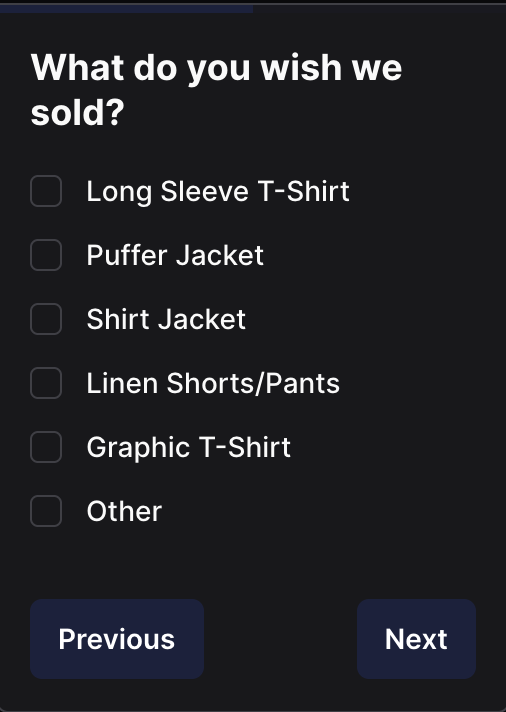
But rather than just validating the product and moving on, Birddogs used KnoCommerce to segment the customers who had specifically expressed interest, then sent them an exclusive early access email before the product went live to the broader public. The result was stronger engagement and sales than expected not because the product was exceptional, but because the communication felt personal. The data told them who to talk to, and they acted on it fast.
Gather feedback with a retail customer experience survey
Every business decision should be backed by data, directly from customers, that tells you how to improve. Surveys are how you get it.
The brands building lasting retail experiences aren’t just optimizing checkout flows or ad spend. They’re listening systematically, acting on what they hear, and closing the loop faster than their competitors.
KnoCommerce is built to help you do exactly that. Book a demo today!