
NPS question format – the psychology behind how you ask the questions and format them
NPS question format is more than a design choice. There is real psychology behind how you ask, present, and position an NPS question, and it meaningfully affects how shoppers respond, how they interpret their customer experience, and how accurately you measure customer loyalty across your customer journey.
NPS has always been a powerful predictor of lifetime value because it measures something deeper than customer satisfaction. It captures identity. It asks a shopper if they would put their name behind your brand.
What most teams overlook is that the NPS question itself has a science behind it. Every decision wording, format, placement, shapes how respondents evaluate their experience and how reliable your nps score becomes as a benchmark metric for growth.
Why NPS Question Matters
NPS, or Net Promoter Score, measures customer loyalty through a simple nps question:
How likely are you to recommend this brand or product to someone you know? The power of that question is not in the score itself; it’s in what it asks a customer to consider. Would they put their name behind your brand? Would they attach their identity to your product? Would they recommend your product to a family member?
That identity lens is why NPS consistently predicts lifetime value more accurately than any single conversion metric. But the real performance gains happen when NPS is tied to actual buying behavior, post-purchase sentiment, and follow-up questions that reveal the main reason behind the score.
Small decisions in wording, layout, and timing shape the quality of your responses.
Kno launched the first NPS tool built specifically for ecommerce, designed to move brands from a static score to contextual, actionable insights rooted in loyalty, revenue, and behavior. When nps data connects directly to order history, attribution, and post-purchase signals, you understand not just what customers felt but why.
When NPS is tied to your store data and buyer declared insights, you go from a static score to a living signal about how customers feel and what they do next.
The science behind NPS question formatting
The NPS survey question looks simple: “How likely are you to recommend us?” But that simplicity is intentional. It creates a clear way to measure loyalty across the ecommerce journey.
Answers to an NPS question are typically a range of 0-10.
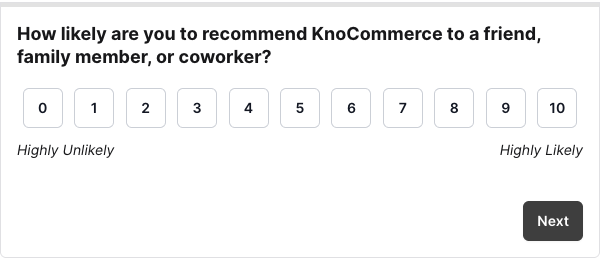
That simplicity creates consistency and makes it easier to compare results across industries, product lines, and types of nps surveys.
The strength of the question comes from how customers interpret it and how their responses fall into meaningful groups that reflect real sentiment.
Based on how shoppers answer, NPS responses are broken down into these three groups:
- Promoters (9 to 10) are loyal customers who will likely recommend your brand.
- Passives (7 to 8) satisfied customers who are not emotionally invested.
- Detractors (0 to 6) unhappy customers who may churn and damage loyalty through negative customer feedback.
Understanding these groups and how they shift across customer segments, touchpoints, and moments of truth gives you a complete picture of customer sentiment.
For ecommerce brands, that decision becomes a reliable indicator of satisfaction, retention, and long-term loyalty. A well-formatted NPS question helps you understand not only how customers feel, but why they feel it.
KNO NPS lets brands analyze NPS results through the lens of what customers actually bought and how they move through your store. You can analyze transactional nps, which captures sentiment after meaningful events, alongside relational nps, which measures broader brand sentiment, and even internal employee nps (enps) for operational clarity.
The psychology behind how you ask the NPS questions
What customers feel about your ecommerce brand and your products matters more than most teams realize. Research shows that 92% of buyers trust recommendations from friends and family more than any type of advertising. Word of mouth remains one of the most effective growth drivers in ecommerce, which is why the psychology behind the NPS question carries real weight and why nps survey questions matter.
How you phrase the question can trigger a positive or negative response. NPS works because it asks for a recommendation, not a rating of csat. Certain words activate a customer’s social identity and shift how they evaluate their experience.
- “Satisfaction” is transactional. It focuses on whether the product or service met basic expectations.
- “Recommendation” is relational. It asks customers to consider if they would attach their reputation to your brand or product.
When you frame the question around recommendation, customers imagine how they would describe your brand to a friend. That mindset moves them out of a single moment and into a broader, more honest reflection of loyalty.
Here are a couple other tips for your NPS survey:
1. Keep it short and simple
You never want to introduce friction. A clean, direct question leads to higher participation and more reliable NPS data. At KNO, we recommend sticking with the classic phrasing. A clear net promoter score survey with a familiar single question drives better response rates and higher-quality survey responses.
“On a scale of 0 to 10, how likely are you to recommend [business or product] to a friend or colleague?”
This format is proven, familiar, and easy to answer.
2. Keep it neutral
Neutral language prevents bias and ensures more accurate customer feedback. Avoid leading language or emotional qualifiers. Neutral wording also helps prevent bias. Brands often skew their NPS results when they treat the question like a checkbox or guide customers toward a preferred response. A neutral question creates cleaner reporting and clearer decisions.
The real insight often appears in the follow-up questions. When your NPS question is clean and unbiased, the open-ended responses that follow become more valuable.
Cleaner questions lead to cleaner reporting, which leads to clearer decisions.
How you ask the NPS question, from the wording to the context to the delivery format, will influence participation and response quality. For ecommerce brands that depend on buyer-declared data, these details directly shape the insights that inform strategy.
3. Ask more than the NPS question
The NPS question is only the starting point. A score without context is just a number, and this is where many ecommerce teams get stuck. This is where additional nps survey questions and follow-up questions bring out valuable feedback and uncover valuable insights.
They either track NPS once a quarter or ignore it entirely because it does not feel actionable. The issue is not the metric. The issue is isolated NPS.
To make NPS meaningful, you need additional questions that explain the score and connect it to real customer behavior. These questions turn the signal into something you can act on.
Here are the types of questions and data points that help brands understand the story behind the score.
A single open-ended question makes the entire survey more valuable:
“What is the primary reason for your score?”
“What could we have done to improve your experience?”
“What did you love most about the product?”
Customers who give a score want to share more. It’s important to give them the space to talk, and you unlock insight that cannot be captured by a number.
Connect responses to order data because to really understand loyalty, you need to know who said it and what they purchased.
- Was this a first time buyer or a repeat customer?
- What product did they buy?
- What channel brought them in?
When NPS sits next to order and customer data inside KNO, you can see patterns across products, cohorts, and purchase paths. This is what makes the data actionable.
Timing has a psychological impact and asking too early captures surface-level reactions. But asking after a real experience captures sentiment that drives retention. After product delivery, after the first use, and after a customer support interaction, for instance.
The closer the question sits to the real moment, the clearer the insight becomes.
How to format NPS questions
How you format the NPS question matters just as much as how you phrase it.
The layout, the number of clicks, and where the question appears in the journey all influence the quality of the response.
Good formatting should feel intuitive.
It should make answering effortless.
Here are a five simple principles that help teams format NPS the right way:
- Keep clicks to a minimum to reduce drop-off.
- Use clear, tap-friendly scales so customers know exactly what to do.
- Place the question after a meaningful moment, such as delivery or first use.
- Meet customers where they already are, like inside their inbox.
- Remove anything that creates hesitation or slows the response down.
Reducing friction is the foundation. Customers should be able to respond quickly. Every extra step creates drop-off, and even small moments of confusion filter out people who would have shared something valuable.
A clean design helps the customer focus on their experience, not the mechanics of the survey.
It also helps to make the action unmistakably clear.
When the scale is easy to tap and the next step is obvious, customers tend to give more honest and consistent answers.
Context plays a role too as formatting is not only visual, it is also about timing.
Asking the question when customers are in the right headspace leads to richer insights. Moments like after delivery, after first use, or following a support interaction bring out more thoughtful responses than asking immediately post-checkout.
Email embedded NPS is one of the strongest formatting choices.
A single click inside the email meets customers where they already spend time. It feels natural, drives higher participation, and produces more accurate sentiment.
When formatting removes friction and aligns with how customers behave, participation climbs. And stronger participation leads to insights you can actually use.
How KNO NPS improves NPS formatting
KNO NPS is built specifically for ecommerce brands, and gives you full control over when to ask the NPS question so it aligns with the customer’s real experience. You can collect a score after delivery, after a product has been used, or at any moment where loyalty is actually forming.
These moments matter because every NPS interaction is another chance to learn from customers willing to share their experiences.
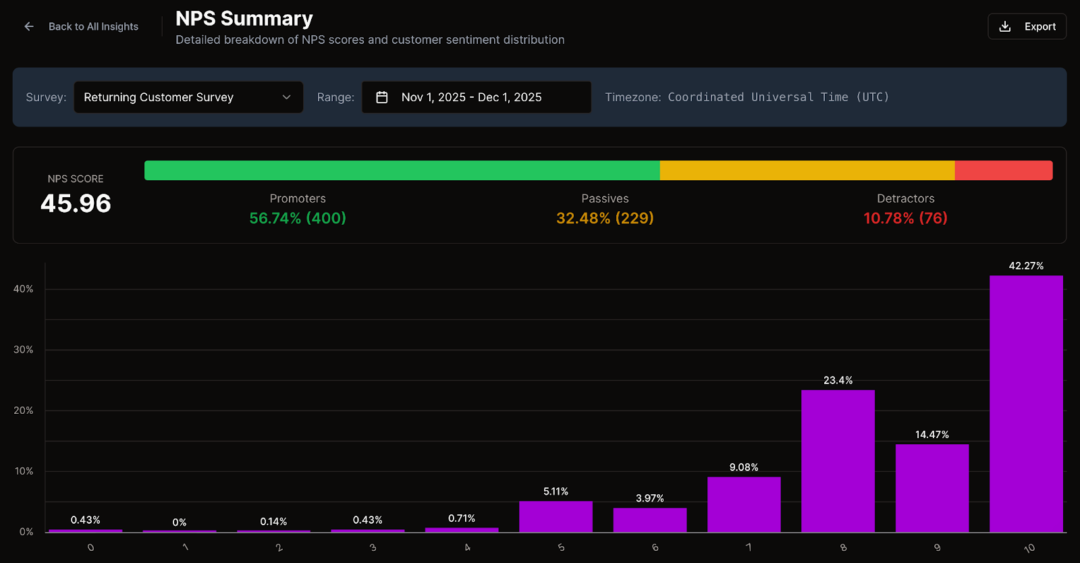
If they take the time to answer, they want to talk to you. When you ask in the right context, their responses reveal how they feel about your brand, not just how they felt in one transaction.
Many brands also include an NPS question in their return-customer surveys. It gives you more visibility into how loyalty changes across repeat purchases. It can also surface cross-sell opportunities by understanding which products deepen trust.
Formatting plays a role here, too. Instead of relying on a thank-you page where intent is low, Kno lets you deliver NPS directly in an email weeks after purchase. Customers can respond with a single click, which leads to higher participation and more accurate sentiment.
The entire workflow runs automatically through your email provider, such as Klaviyo.
Smart formatting and thoughtful placement improve participation. Better participation leads to stronger insights. And stronger insights lead to better decisions.
How to use your NPS survey data
Collecting NPS is only the beginning. The real value comes from what you do with the responses, and the strongest brands treat every score as a signal that should move into the right workflow rather than sit in a dashboard.
Routing responses to the right places gives each score a clear purpose.
- Detractors can trigger alerts inside CX tools like Gorgias so your team can step in before the customer churns.
- Promoters can flow directly into referral or UGC journeys in Klaviyo where their enthusiasm actually drives growth.
- Passives can be shared with product and operations teams to uncover early patterns that might not show up in traditional reporting.
Once these workflows are in place, NPS becomes a system that helps you recover customers, strengthen loyalty, and improve the overall experience.
This is why the best brands do not measure success by the score alone.
A high number means very little if it does not lead to better outcomes. What matters is how the insights are used.
Teams that use NPS well focus on actions such as saving detractors, resolving product issues that surface in responses, and increasing LTV for the cohorts that show strong loyalty signals.
That is the real impact of NPS when it is connected, contextual, and supported by thoughtful follow-up questions. It becomes a source of continuous improvement rather than a metric reviewed once a quarter.
NPS matters for the growth of your ecommerce brand
When NPS is paired with your post-purchase survey data inside KNO, you get a single source of truth for customer satisfaction, loyalty signals, and the sentiment that drives real retention.
Brands that treat NPS as part of their broader customer understanding strategy gain an advantage. They see which products inspire loyalty, which moments create friction, and which customers are most likely to come back. When those insights live in one place, every decision becomes clearer.
If you want to see how NPS and PPS work together inside KNO, book a demo here.