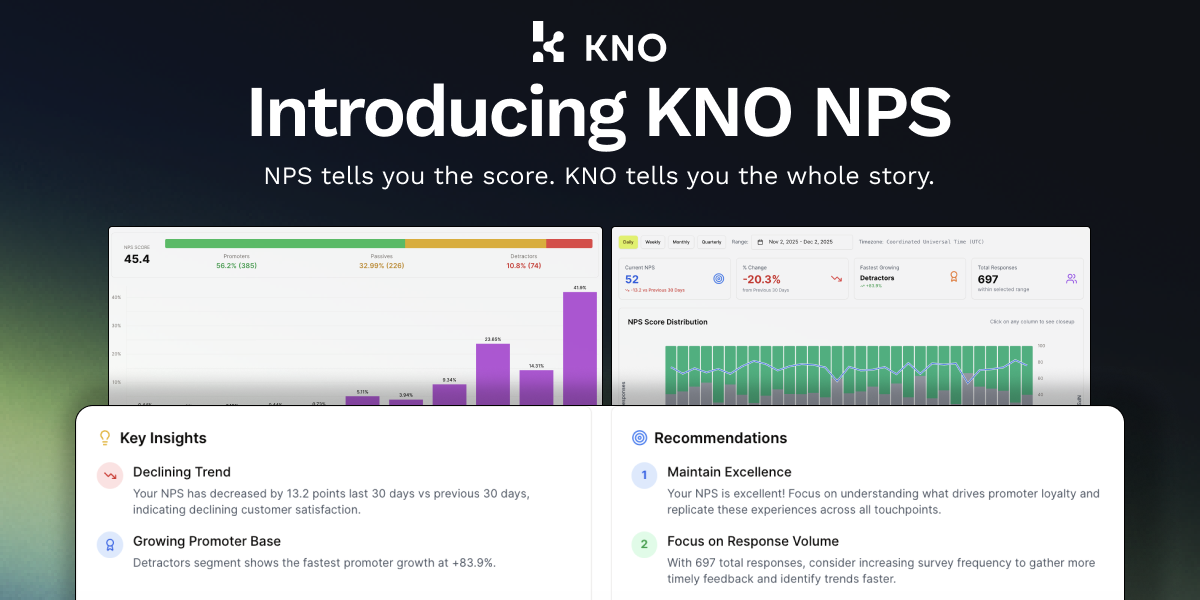
For years, NPS was treated like a dusty corporate survey metric… something software companies and airlines obsess over.
NPS is powerful because it goes beyond satisfaction. It measures identity. “Would you recommend us?” forces a customer to consider:
- Would I put my name behind this brand?
- Would I stake my reputation on this?
That decision-making process is why NPS consistently predicts LTV more accurately than any single conversion metric.
It’s helpful, sure. It tells you what convinced a customer to hit “checkout.” But it doesn’t tell you a lot about their psychology or their intent.
This is exactly why we built our own NPS product at KNO, explicitly designed for brands that want to combine loyalty intelligence with actionable customer insights far beyond a simple scale.
The NPS problem in ecommerce
If you’ve tried adding NPS to your tech stack, you’ve probably run into at least one of these problems:
- The score comes in, but it’s not tied to order data
- Detractors complain, but no automated loop is set up to catch them
- Promoters rave, but nothing triggers a referral ask
- Comments pile up in a spreadsheet with no trend analysis
- Reporting looks like: “Your NPS is 42” with zero next steps
- Data lives in a silo far from your post-purchase, onsite, or CRO insights
These break the purpose of having an NPS to begin with. Data is just data. Without a way to connect it to something meaningful, it’s fairly meaningless.
Our NPS at KNO avoids these common problems.
Introducing KNO NPS: The first ecommerce-native approach to measuring loyalty
We designed our new NPS product for one purpose: turning customer sentiment into meaningful action.
Here’s what makes it different.
Email-Embedded NPS for Higher Response Rates
Your customers answer the first NPS question inside the email body without being redirected away. This increases response rates and the honesty of those responses.
You’ll hear what customers actually feel, not what they’re willing to say after clicking through a survey wall.
Automated Flows That Close the Loop Instantly
Because NPS integrates directly with tools like Klaviyo, you can:
- Send promoters to a referral flow
- Offer a gift to high-LTV promoters
- Trigger tickets for detractors
- Route responses to CX agents
- Personalize flows based on NPS segment
Loyalty intelligence → loyalty action → loyalty improvement.
NPS Tied Directly to Order Data
With KNO NPS, you can track responses by
- Product
- Variant
- Fulfillment speed
- Customer lifecycle stage
- of previous orders
- Discount type
- Acquisition channel
- Subscription cohort
You can finally answer: What makes promoters promoters? Where are detractors falling off? And which products create loyal customers?
NPS Reporting That Actually Tells a Story
Traditional NPS dashboards: a single number, a bar chart, maybe a CSV export. KNO’s NPS reporting highlights
- Promoter and detractor themes
- Segment-specific trends
- Long-term score tracking
- Benchmarking (coming soon)
- Word clouds and comment grouping
- Cohort analysis
- Loyalty drivers at a glance
You don’t have to decode your own data. Your dashboard gives you the narrative.
Unified Customer Truth: PPS + NPS + Email Surveys
This is the biggest unlock. For the first time, you can combine three survey types under one roof:
- Why customers bought (post-purchase surveys)
- Why they return (NPS)
- What they think mid-journey (email or reactivation surveys)
NPS alone isn’t the answer. Insights are. And KNO turns them into strategies.
The psychology behind NPS questions (and why format matters more than you think)
If you’ve used an NPS tool before, you’ve probably seen wildly inconsistent data across channels.
Half the time, response rates are low. The other half, the open-ended responses are so broad they’re useless.
That’s not a brand problem. It’s a format problem.
Here’s the psychology behind why format matters:
1. Email-embedded NPS gets more honest responses
When a customer can tap a score inside their inbox—without clicking out—you catch their instinctive reaction.
Every extra click = a drop in truthfulness and volume.
2. The wording triggers social identity
“Satisfaction” is transactional.
“Recommendation” is relational.
People answer NPS differently because they’re imagining explaining your brand to a friend. That unlocks motivations you don’t get anywhere else.
3. The follow-up question is where the insight actually lives
“What’s one thing we could improve?”
“What nearly stopped you from purchasing?”
“What made you choose us?”
Small, standardized prompts create data that can be segmented, grouped, and trended—if the tool you use doesn’t let the follow-up scatter into chaos.
This is why standardized NPS frameworks outperform “write whatever you want.”
Cleaner questions → cleaner reporting → clearer decisions.
But again… most NPS tools weren’t built for ecommerce realities.
KNO NPS is now live
Ready to measure loyalty, not just conversion?
KNO’s NPS is officially live.
Your customers have opinions. We make them make sense.