
The Future of Ecommerce: What 2026 Data Reveals About AI, Attribution, and Channel Shifts
Ecommerce has never stood still.
Consumer expectations shift. New channels emerge. Technologies reshape how people search, discover, and evaluate products long before they reach checkout in a brand’s ecommerce store.
What makes the future of ecommerce especially compelling right now is how many of these shifts are happening at once.
Shoppers are using artificial intelligence (AI) tools as search engines. Social media platforms continue to reshape how brands are discovered, accelerating the rise of social commerce across major sales channels. Attribution models are becoming harder to trust. And the path to purchase rarely follows a straight line across modern marketing channels.
Why is there a shift happening?
At KnoCommerce, we see these changes reflected directly in customer feedback collected through post-purchase surveys across thousands of ecommerce brands. These insights help brands better understand their customer segments, revealing where new customers discovered them, what influenced the purchase decision, and what nearly prevented checkout.
When we compare this data with broader ecommerce trends for 2026, several patterns become clear for any ecommerce business focused on sustainable growth and customer retention.
Acquisition channels are shifting. Some are accelerating while others plateau. At the same time, shoppers are becoming more deliberate about how they research products, compare brands, evaluate pricing, and decide where to spend.
Add AI into the mix and traditional marketing strategy playbooks start to fall behind real customer behavior.
The brands that will win in the coming years are not simply adopting new tools. They are combining behavioral data, AI-powered workflows, and direct customer insight to understand what actually drives purchase decisions.
These shifts are reshaping how ecommerce brands acquire customers, refine messaging, improve conversion rates, reduce friction at checkout, and strengthen long-term retention. They offer a clear preview of where ecommerce is heading next.
AI and ChatGPT are a new discovery channel
AI is now embedded in ecommerce from both sides of the transaction. Brands rely on it to automate workflows, personalize customer experience, and improve user experience. Shoppers use it to research products, compare options, and validate decisions before buying.
As a result, discovery is changing.
What once started with scrolling social feeds or traditional search engine results increasingly begins with high-intent questions asked directly to AI assistants.
ChatGPT is the most widely used of these tools, and it is quickly becoming one of the fastest-growing attribution sources for ecommerce brands.
Instead of passively browsing, shoppers now ask:
What should I buy?
Which brand can I trust?
What’s the best option for my needs?
This behavior signals stronger purchase intent than many traditional top-of-funnel channels and helps brands build trust earlier in the customer journey.
KnoCommerce data reflects this shift. AI-driven discovery is in a clear hypergrowth phase:
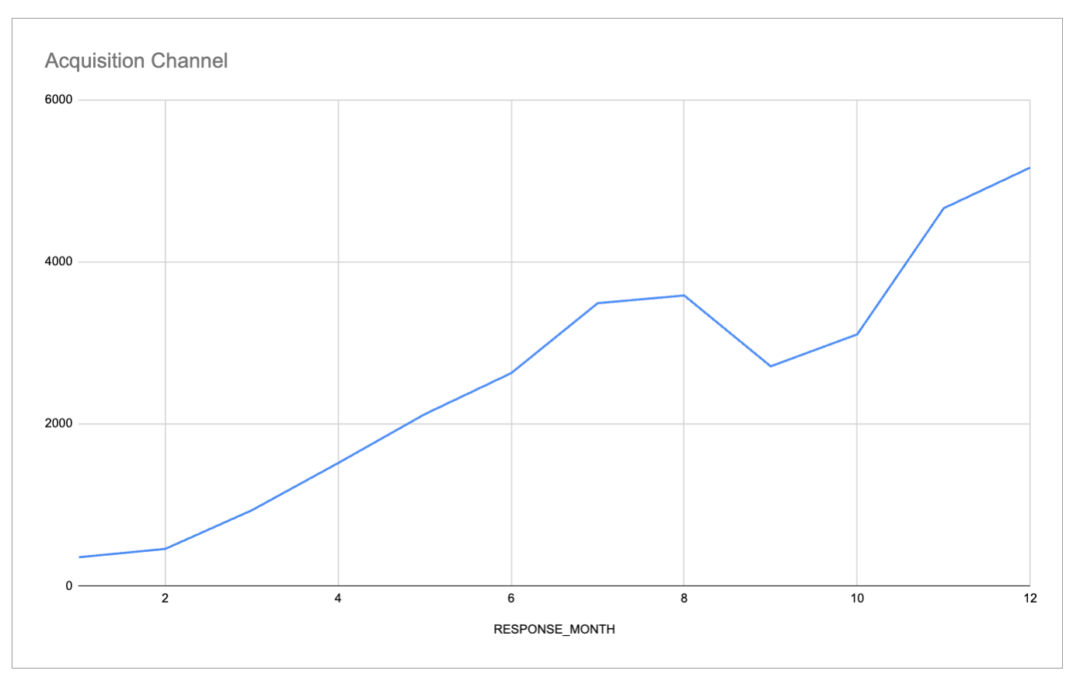
- 25–30% month-over-month growth, the fastest among acquisition channels
- 12× attribution growth in 2025, representing an annual increase exceeding 1,100%
- Industry reporting shows AI-driven traffic to U.S. retailers surged 800%+ year over year during Black Friday
AI is no longer a background assistive technology. It is becoming part of serious purchase journeys across every major ecommerce platform.
This change is now visible in customer responses. More shoppers report discovering brands through ChatGPT and similar AI tools, turning AI into a measurable discovery channel rather than an invisible influence.
Commerce platforms are already adapting. In early 2026, Shopify introduced infrastructure designed to support AI-native shopping experiences, enabling merchants to sell directly within AI-powered environments while improving the end-to-end online store experience.
As Shopify explained:
“Merchants will be able to sell in an embedded experience and manage it directly from the Shopify Admin. The Agentic plan gives merchants the ability to list their products in Shopify Catalog to surface exactly what customers want in seconds.”
AI is moving beyond operational support and becoming part of the shopping interface itself, influencing how product pages are surfaced, evaluated, and purchased.
For ecommerce brands, this creates both opportunity and measurement challenges. If AI influences discovery but is not captured in attribution reporting, performance metrics become distorted. Sales driven by AI may appear as direct traffic or be misattributed to other marketing channels.
That is why more brands are updating post-purchase surveys to include AI tools as dedicated response options. When customers self-report discovering a brand through AI, emerging behavior becomes visible much earlier.
KnoCommerce predicts AI-driven discovery will account for 5–10% of brand discovery within the next 12–18 months, placing it alongside established channels like podcasts and influencer marketing in its contribution to customer acquisition and ecommerce revenue growth.
AI is becoming embedded in the earliest stages of purchase intent, giving brands that measure it properly a clearer view of how modern buying decisions form.
Email and direct mail are having a resurgence
While AI is accelerating discovery at the top of the funnel, a different shift is happening closer to conversion.
Owned channels like email marketing and direct mail are regaining momentum as reliable drivers of revenue, particularly among shoppers who already know the brand and belong to existing customer segments within a brand’s customer base.
KnoCommerce data shows both channels experiencing steady attribution growth of 6–8% month over month, signaling renewed engagement rather than gradual decline. After years of brands prioritizing algorithm-driven reach on social media platforms like TikTok, many are refocusing on channels they fully control as part of a broader ecommerce marketing strategy.
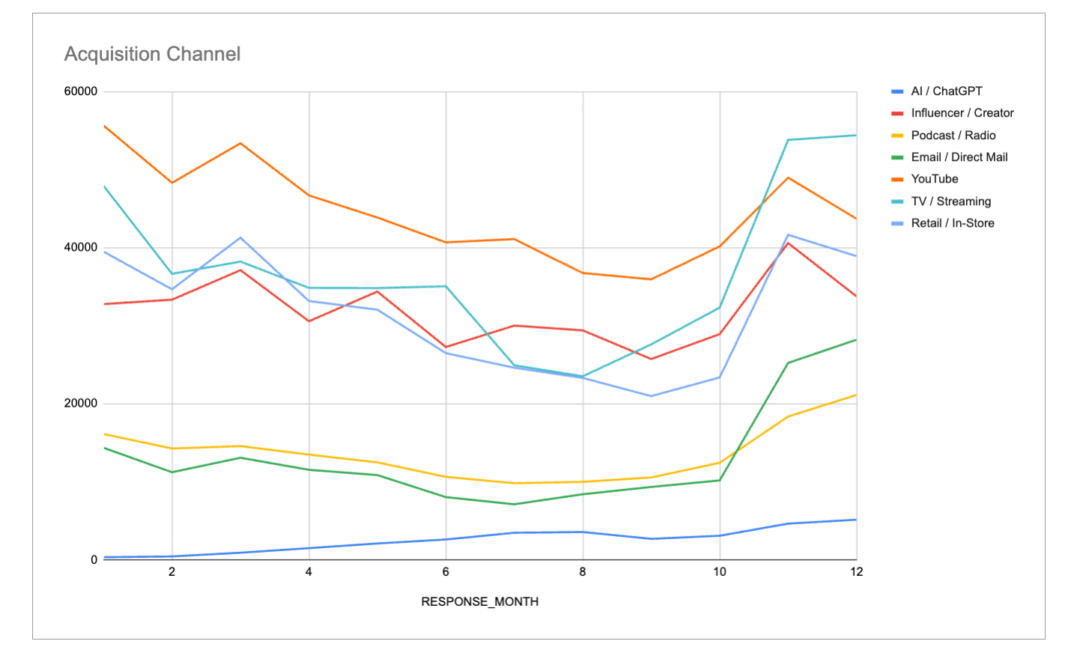
Email and direct mail operate differently from paid acquisition. Brands decide when messages are delivered, who receives them, and how the experience is personalized using real-time behavioral triggers. There is no dependence on shifting platform algorithms or rising auction costs to maintain performance.
That control becomes more valuable as customer acquisition cost continues to climb and paid channels grow more volatile, making lifecycle automation increasingly important.
These channels also serve a different role in the customer journey. AI-powered discovery may introduce new shoppers, but owned channels help bring them back.
They re-engage past buyers.
They reinforce brand familiarity.
They create predictable touchpoints that guide customers toward repeat purchases, stronger customer loyalty, and participation in a brand’s loyalty program.
For many ecommerce brands, this makes email and direct mail foundational to retention and lifecycle marketing rather than optional promotional tactics that sit outside core marketing efforts.
The renewed interest is not about revisiting legacy tactics. It reflects a strategic shift toward performance stability. Audiences reached through owned channels already recognize the brand, making conversion pathways shorter and more efficient while increasing average order value.
This is especially important as brands look for ways to offset rising acquisition costs and improve customer lifetime value across their existing customer base.
That visibility matters because owned channels rarely work in isolation. Laura Geller Beauty, for example, used post-purchase surveys to understand how different marketing touchpoints influenced purchases.
They discovered that customers exposed to TV campaigns often converted through digital channels later, revealing a halo effect that helped the team make more confident channel investment decisions instead of over-relying on paid social alone.
Owned channels help redistribute performance across the funnel in a more omnichannel strategy:
- Top of funnel: AI and emerging discovery platforms introduce potential shopper
- Mid-funnel: Retargeting and social proof reinforce consideration
- Bottom of funnel: Email and direct mail convert and re-engage known customers
Brands that understand this balance can allocate resources more effectively instead of overinvesting in unpredictable acquisition channels.
Attribution visibility becomes critical here. Understanding which channels influence revenue allows brands to scale what is working and reduce spend where returns are flattening.
As ecommerce grows more complex, the advantage increasingly belongs to brands that combine emerging discovery channels with stable owned-channel strategies that drive retention and repeat revenue.
Email and direct mail are proving that control, familiarity, and predictability still matter, especially as growth efficiency becomes just as important as growth speed.
Legacy channels are stalling
Channels that once dominated brand discovery are no longer driving the same momentum.
Influencer marketing, YouTube, and even traditional retail environments still play a role in the customer journey, but their influence as primary discovery engines is softening.
Influencer marketing is a clear example. What once felt novel now feels saturated. Audiences are accustomed to sponsored posts and creator promotions, making these placements easier to scroll past and harder to distinguish from the volume of branded content filling social feeds.
This doesn’t make influencer marketing ineffective. It simply shifts its role within a broader ecommerce growth strategy.
Instead of driving strong discovery and purchase intent, influencer content now leans more toward passive awareness among broad demographics. Shoppers may recognize a brand name, but they are less likely to treat creator promotions as a decisive moment in their purchase journey.
KnoCommerce data reflects this plateau. Influencer attribution remained largely flat year over year, signaling that the channel has reached a maturity point where incremental growth is harder to unlock.
Other traditional discovery environments are seeing similar slowdowns:
- Retail and in-store (brick-and-mortar) attribution declined roughly 1
- YouTube experienced the steepest drop, declining 2–3% month over month
- TV and streaming stabilized, maintaining influence but showing limited growth acceleration
These shifts suggest consumer discovery behavior is fragmenting rather than concentrating within a few dominant channels.
According to KnoCommerce insights, emerging AI-driven discovery is beginning to absorb attention that once flowed through platforms like YouTube and physical retail. As shoppers turn to AI tools for recommendations and product research, traditional browsing environments capture a smaller share of early discovery behavior.
Legacy channels are not disappearing. They remain important for reach, credibility, and reinforcement across the customer journey.
But their role is changing.
Instead of serving as primary discovery engines that introduce shoppers to new brands, many are becoming supporting touchpoints that reinforce familiarity after initial discovery happens elsewhere.
For ecommerce brands, this signals a strategic shift. Relying on legacy channels alone is unlikely to produce the same growth outcomes they once delivered.
Modern channel strategies require balancing emerging discovery environments with established platforms that still influence consideration and trust, even if they no longer drive first-touch momentum.
Understanding where legacy channels contribute versus where they are losing influence allows brands to reallocate budget toward higher-growth discovery sources without abandoning the ecosystem that supports conversion.
Ecommerce brands can’t rely on last-click attribution
There was a time when a single ad impression could drive a purchase decision. That path is now rare.
Today’s shoppers move across devices, sales channels, and digital environments before converting on an ecommerce store.
Discovery is no longer a moment. It is a sequence shaped by customer behavior across multiple brand interactions spanning devices, platforms, and digital marketing channels.
AI has accelerated this shift by compressing research, comparison, and recommendation into a single interaction. Instead of opening ten tabs and scanning reviews across sites, shoppers can now ask AI tools for summarized evaluations, alternatives, and validation in seconds.
This makes the customer journey faster, but also more layered.
Multiple touchpoints influence a decision long before a final click happens, often influencing outcomes like average order value and post-purchase engagement.
| Channel | Avg MoM Growth | Growth Type |
| AI/ChatGPT | +25-30% | 🚀 Hypergrowth |
| Email/Direct Mail | +6-8% | 📈 Strong |
| Podcast/Radio | +2-3% | 📈 Moderate |
| TV/Streaming | +1-2% | ➡️ Stable |
| Influencer/Creator | ~0% | ➡️ Flat |
| Retail/In-Store | -1% | 📉 Slight decline |
| YouTube | -2-3% | 📉 Declining |
That is why ecommerce brands can no longer rely on last-click attribution models to understand performance or properly benchmark channel impact using surface-level kpis.
AI is now part of that ecosystem. Shoppers actively search on platforms like ChatGPT for product recommendations, comparisons, and purchase guidance. These interactions influence decisions earlier in the journey but rarely receive attribution credit under traditional models.
When AI-driven discovery is not measured, performance appears to come from direct traffic or other channels that happened to be last in the path.
This creates blind spots in marketing efforts, strategy, and budget allocation across the broader omnichannel ecosystem.
Brands that want a clearer view of performance are shifting toward customer-declared attribution methods, where shoppers self-report how they discovered a brand. Post-purchase surveys help fill the gaps left by clickstream-based reporting by capturing the influence of channels that traditional analytics miss.
KnoCommerce has seen this approach help brands uncover discovery sources that would otherwise remain invisible in attribution dashboards. Understanding where influence truly begins allows teams to make more informed channel investment decisions.
For example, HexClad used post-purchase survey data to better understand which marketing efforts were influencing purchase decisions beyond last-click reporting. Customer responses revealed how different touchpoints worked together, helping the team evaluate performance more accurately and allocate budget based on real influence rather than surface-level metrics.
As AI becomes a legitimate acquisition channel, the limitations of last-click attribution will become even more pronounced.
Ecommerce brands cannot afford to ignore AI’s role in discovery. Consumers are already using AI platforms to search for products, compare options, and decide what to buy. If these interactions are not captured in measurement frameworks, brands risk misinterpreting performance and underinvesting in emerging channels.
Measurement must evolve alongside discovery behavior.
Brands should also prepare for AI-driven discovery by ensuring their digital presence is optimized for how large language models interpret information. This includes making product information structured, descriptive, and easy for AI systems to parse, potentially even integrating with augmented reality experiences.
Key areas to optimize include:
- Product descriptions that clearly explain features and benefits
• FAQ pages that address common purchase questions
• Customer reviews that provide authentic product validation
• Site copy that reflects natural language search patterns
• Structured product data that improves machine readability
These improvements do more than support SEO. They make brand and product information more accessible to AI systems that increasingly shape discovery and recommendation experiences.
Brands that measure influence across the entire journey can invest with greater confidence and avoid scaling channels that only appear effective on the surface.
Know what and how to measure attribution
As discovery becomes more fragmented, measurement has to evolve with it.
Ecommerce brands are now navigating a web of influence that spans AI platforms, owned lifecycle channels, influencers, paid media, organic discovery, and offline touchpoints across an increasingly omnichannel environment. No single marketing channel operates in isolation, and no single click tells the full story.
What matters is understanding how these channels work together to shape measurable customer behavior.
That requires stronger signals, clearer metrics, and modern measurement frameworks built for today’s customer journey rather than relying on outdated attribution shortcuts.
Post-purchase attribution is becoming one of the most valuable measurement points because it captures what traditional analytics cannot and helps teams optimize performance with greater precision.
When customers are asked where they first heard about a brand, patterns emerge that no pixel, cookie, or clickstream model can detect. Shoppers often discover a brand in one environment, research in another, and convert somewhere entirely different — influencing everything from conversion rates to average order value.
Without customer-declared insight, those early influences remain invisible, creating gaps that weaken marketing strategy, distort KPIs, and limit visibility into true marketing efforts.
This is why more ecommerce brands are incorporating post-purchase surveys into their attribution approach as a core part of their ecommerce growth strategy. Direct responses help connect the dots between discovery, consideration, and conversion across marketing channels that rarely appear together in analytics dashboards.
Instead of guessing which channels deserve credit, brands can hear it directly from customers and better understand how experiences shape customer relationships.
These insights also reveal how different customer segments behave, what builds trust at critical decision points, and which interactions most influence long-term customer retention.
These signals become even more important as AI-driven discovery accelerates. Interactions inside AI platforms often leave little trace in traditional reporting tools, making customer-reported attribution one of the only reliable ways to measure influence in real-time.
KnoCommerce helps brands uncover these signals and understand where customers truly come from by translating post-purchase responses into clear, actionable attribution insights that strengthen ecommerce marketing performance.
When brands can see how channels contribute across the full journey, they can allocate budget more confidently, reduce wasted spend, and optimize marketing efforts that improve the overall customer experience.
Better visibility also helps brands benchmark performance more accurately, identify friction that leads to cart abandonment, and invest in moments that drive stronger customer loyalty and more repeat purchases.
Attribution is no longer about identifying the final click.
It is about understanding the full path to purchase and using those insights to grow customer lifetime value, strengthen the customer base, and scale sustainable ecommerce success.
What the future of ecommerce demands from brands
The next phase of ecommerce will reward clarity over noise.
Growth will not come from being everywhere. It will come from showing up in the moments that matter and understanding how influence actually happens.
Winning ecommerce in 2026 means optimizing for AI-driven discovery alongside traditional search visibility. Brands must structure product information so AI systems can interpret and surface it in recommendations while delivering high-quality digital experiences.
This includes:
- Clear product titles and benefit-focused descriptions
• Structured product data that improves machine readability
• FAQ content that answers real purchase questions
• Customer reviews that provide authentic validation
• Site copy written in natural, conversational language
At the same time, brands must strengthen owned channels that drive retention and reactivation. Email, SMS, and personalized lifecycle messaging create stability because they do not depend on platform algorithms or rising media costs.
These channels help brands maintain relationships with loyal customers, introduce new products, and guide buyers through a connected online experience.
Brands that invest in SEO, AI discoverability, lifecycle automation, and coordinated cross-channel strategies will be positioned to rank higher across both traditional discovery engines and AI-powered recommendation systems.
Sustainable ecommerce success will come from brands that understand their target audience, refine ecommerce marketing across every touchpoint, and continuously improve the full customer experience.
Book a demo to see how KnoCommerce helps you measure what truly drives discovery and growth.