
In 2026, ecommerce brands aren’t struggling to collect data. They’re struggling to trust it.
Cookies are disappearing. Privacy updates continue tightening. Attribution models that once guided budget decisions now leave noticeable gaps between reported performance and reality.
The dashboards still fill up anyway.
Traffic sources. Conversion rates. Campaign reports. Endless charts suggesting everything is measurable.
But measurement without confidence makes growth harder, not easier.
Behavioral analytics can show where customers clicked or where they dropped off. What they rarely explain is why someone trusted your brand enough to buy, what convinced them to purchase that day, or what nearly stopped them at the last second.
And that “why” is often the difference between scaling efficiently and chasing month-to-month performance swings.
The most effective ecommerce growth strategy approaches now combine traditional analytics with zero-party data, information customers willingly share through surveys, quizzes, and feedback moments across the customer journey.
Instead of guessing motivations from behavior alone, brands are asking customers directly, and that clarity turns customer data into a scalable growth strategy that strengthens long-term ecommerce success.
What is an ecommerce growth strategy?
An ecommerce growth strategy is a holistic, long-term plan for how brands attract new customers, convert shoppers into buyers, retain them over time, and continuously improve what they offer across multiple marketing channels.
Many strategies focus heavily on channels, technology, and execution. Paid media expansion, conversion testing, and email marketing and automation flows all play an important role in driving performance.
The challenge is that these approaches often overlook the customer’s voice and the broader customer experience.
Growth decisions are frequently based on trackable customer behavior such as cart abandonment rate, bounce rate, or ad engagement. Those metrics provide valuable signals about how shoppers move through the funnel and where friction might exist.
But this is only one part of the puzzle.
Behavioral analytics tell you what customers are doing however, they rarely tell you why.
A shopper abandoning checkout could be reacting to unexpected shipping costs. Another may hesitate because sizing feels unclear. Someone else might still be comparing competitors before committing. Inside an analytics dashboard, those motivations look identical even though they require completely different solutions.
Without customer context, brands risk optimizing for symptoms rather than solving the underlying problem.
A strong ecommerce customer data strategy fills those gaps by combining performance metrics with direct feedback from the people actually making purchasing decisions.
Challenges with traditional ecommerce growth strategies
Most ecommerce growth strategies look sophisticated on the surface.
Dashboards are full. Attribution models are configured. Campaign performance is tracked across channels. Teams move faster, test more often, and optimize constantly.
But many brands still struggle to answer a simple question:
What actually influenced the customer to buy?
The gap between reported performance and real customer decision-making creates hidden inefficiencies. Budgets get misallocated. Optimizations fix the wrong problems. Growth becomes harder than it should be.
These challenges typically show up in four ways.
1. Misleading attribution signals
The first challenge starts with how performance is measured.
Acquisition spend rises without a clear understanding of which channels actually influence purchasing decisions.
Marketing teams double down on campaigns that appear successful in attribution dashboards but fail to reflect how customers actually discovered the brand through social media, search, word of mouth, or influencer recommendations.
The result: budget allocation based on reporting models rather than customer reality.
2. Behavioral data explains outcomes — not motivations
Attribution gaps are only part of the visibility problem.
Even when behavioral data are accurate, they introduce another limitation.
Analytics can show what happened. They rarely explain why it happened.
A dashboard might reveal customers abandoning at checkout, but it cannot clarify whether the hesitation stemmed from pricing concerns, unclear product information, weak social proof, or delivery friction.
Each scenario requires a different fix. Without insight into motivation levels, optimization efforts become guesswork.
3. Rising acquisition costs increase the risk of guessing wrong
This uncertainty becomes more expensive as acquisition costs continue to climb across ecommerce.
Efficiency matters more than ever, yet many teams still make investment decisions without a complete view of customer intent.
When every dollar must work harder, incomplete insight becomes an expensive liability.
4. Competitor-led strategy creates false signals
Under pressure to grow, teams often look outward for direction.
Some brands copy competitor tactics or chase emerging channels simply because others appear successful there.
But visibility into competitor performance is always partial.
Without customer-backed insight, these moves become educated guesses rather than repeatable growth levers.
Taken together, these challenges point to a deeper issue: brands are optimizing around incomplete information.
A sustainable ecommerce growth strategy depends on understanding both performance signals and customer motivations. One without the other creates blind spots that compound over time.
2 types of data every growth strategy needs
Successful ecommerce brands rarely rely on a single source of insight. Instead, they combine multiple perspectives to understand the full customer journey.
-
Behavioral data shows what customers do
Behavioral insights include clicks, sessions, purchases, bounce rates, and ad engagement metrics tracked through Shopify analytics, advertising platforms, or website tools within the ecommerce platorm ecosystem. These signals are essential for measuring performance and identifying friction.
-
Zero-party data explains why they do it
Zero-party data comes directly from customers through surveys and feedback experiences. Post-purchase surveys, onsite questionnaires, or follow-up email surveys allow shoppers to explain how they discovered a brand while creating actionable customer feedback loops.
When combined, these two data types create a much clearer picture of growth opportunities.
Brands that want stronger insights often start by asking better questions, which means building surveys that move beyond surface-level responses.
The four growth levers data unlocks across the customer journey
Customer data plays a role at every stage of an ecommerce scaling strategy, from acquisition and conversion to retention and product development.
Understanding motivation enables brands to make confident decisions rather than reactive ones.
1. Use customer data to improve acquisition
Ecommerce brands do not have it easy when it comes to attracting new customers.
Competition continues to increase, third-party data has largely disappeared, and ongoing privacy restrictions make it harder than ever to measure acquisition performance with confidence. Marketing teams are expected to justify spend while relying on attribution models that often tell an incomplete story.
Customer acquisition costs have risen sharply in recent years, increasing nearly 40 percent compared to two years ago and averaging around $80 across industries.
Diversifying spend across channels can help manage risk. But when attribution data is unreliable, spreading budget across platforms like TikTok, social media, or search engine campaigns can quickly turn into a shot in the dark.
Customer insights also help brands better understand the target audience segments most likely to convert rather than relying solely on platform reporting.
Without cookies, it is increasingly difficult to know exactly where traffic originates. And even when referral sources appear clear, brands are still left guessing why a customer ultimately chose to purchase.
Attribution survey data helps close that gap.
By asking questions such as “How did you first hear about us?” and “What made you decide to buy today?” in post-purchase surveys, brands gain visibility into both discovery and decision-making.
Comparing survey responses against UTM parameters or referral traffic often reveals discrepancies between platform reporting and customer recall. Those differences highlight where channels may be overcredited or undervalued.
Survey insights also make it easier to distinguish between acquisition sources that drive high-intent buyers and those that primarily attract browsers or cart abandoners.
With that clarity, teams can confidently reallocate budget toward the channels customers themselves credit for influencing their purchase.
As one example, Backbone Media used KnoCommerce to investigate an unexpected sales spike for a client.
Post-purchase survey responses revealed that customers were referencing a favorable third-party review from Consumer Reports as a key purchase driver. The feature wasn’t appearing in attribution reporting, so the team initially had no visibility into its impact.
Once identified, Backbone quickly leaned into the momentum. They amplified the endorsement across paid and organic social, incorporated it into creative, and turned a previously invisible influence into a measurable growth lever.
2. Use customer data to improve conversion
Most ecommerce brands invest heavily in traditional conversion rate optimization strategies like heatmaps, A/B testing, and click tracking. These tools are valuable for identifying where customers drop off during the buying process.
The challenge is that they rarely explain why.
Customers abandon purchases for a wide range of reasons. Price sensitivity. Unexpected shipping costs. A confusing checkout experience. Lack of reviews or social proof. Inside analytics dashboards, those moments often look the same even though the underlying hesitation can be completely different.
A strong example comes from Prismfly, which teamed up with KnoCommerce to understand what truly influenced purchase decisions for CrunchLabs. Post-purchase survey insights revealed the trust signals and motivations traditional analytics missed, allowing Prismfly to refine on-site testing and merchandising around what customers actually valued. The result was a 10.2% revenue lift driven by reducing friction and reinforcing buyer confidence.
With ecommerce conversion rates typically hovering between 2.5% and 3%, even small improvements can have a meaningful impact on revenue.
Modern CRO strategies combine behavioral signals with direct customer feedback collected immediately after purchase. Surveys allow brands to ask the questions analytics tools simply cannot answer while the experience is still fresh in the customer’s mind.
Some of the most effective conversion-focused survey questions include:
- “What nearly stopped you from buying?” to surface friction points invisible in behavioral data
- “What made you decide to buy today?” to uncover purchase motivations and the language customers naturally use to describe value
- “Were you able to find what you were looking for?” to identify navigation challenges and UX gaps
Understanding the motivations behind customer spending decisions is often the difference between incremental testing and meaningful improvement.
If you are unsure what to ask your customers, KnoCommerce offers over 200 vetted survey questions organized by vertical. You can explore examples in this ecommerce survey questions guide or browse the full post-purchase survey question library.
How to Put the Data Into Action for Growth
Collecting feedback is only valuable if it leads to change.
Recurring friction around shipping costs may signal the need for clearer pricing transparency on product pages. Confusion around sizing can point toward adding guides or improving product imagery. Navigation challenges may highlight opportunities to simplify category structures or checkout flow.
Open-ended survey responses can also become some of the most effective creative inputs a brand has.
Customers often describe product benefits more clearly than marketing teams ever could. Using that language directly in ad creative, landing page copy, or product descriptions helps messaging resonate because it reflects how shoppers actually think about the product.
Survey data can also feed directly into CRO workflows.
Low satisfaction scores or recurring friction mentions can automatically trigger alerts in real-time for CX, product, or web teams to investigate. Positive sentiment, on the other hand, can be shared with creative teams to reinforce messaging that already resonates with buyers.
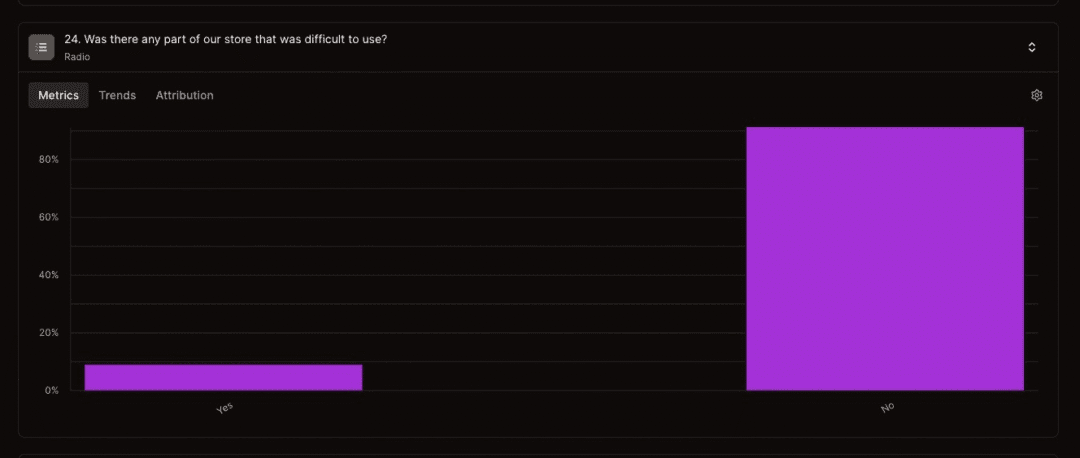
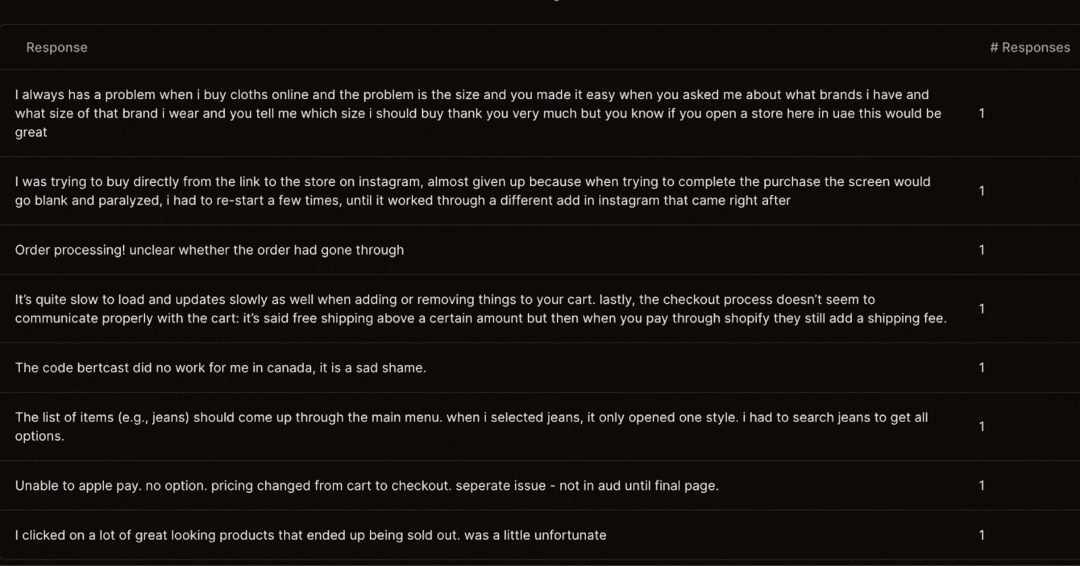
True Classic, a men’s apparel brand, used this approach by asking shoppers whether specific parts of the website experience felt difficult or caused friction during their purchase journey.
Customers first responded to a simple yes-or-no question, creating an easy signal for identifying issues at scale. Those who reported challenges were then prompted with an open-ended follow-up asking how the experience could improve.
The result was both quick, digestible data and deeper qualitative insight into real customer experiences, allowing the team to prioritize improvements with confidence.
3. Use customer data to improve retention
One of the most sustainable ways to grow your ecommerce brand is by improving your retention rate. Repeat customers are easier to sell to, spend more per purchase, can generate up to 44% of a store’s total revenue, and contribute significantly to long-term customer lifetime value across a growing customer base.
The problem is that many growth strategies approach retention too broadly. Generic email flows, blanket discount codes, and one-size-fits-all loyalty programs treat every customer the same, even though their reasons for buying are often very different.
Effective retention strategies need to be personalized and built around meaningful customer segments. In fact, 65% of customers view targeted promotions as a primary purchase motivator.
To use this survey data to improve retention strategies, start by segmenting surveys based on customer type. New and returning customers have different motivations, expectations, and friction points, so asking the same questions to both groups often limits what you can learn.
Next, focus on understanding purchase intent.
Ask questions like “Was this purchase a gift?” If the answer is yes, the follow-up shouldn’t push a reorder. Instead, offer gift options or a discount tied to their next gifting occasion. Retention improves when messaging reflects why someone bought in the first place.
NPS also plays a critical role, but only if you act on both ends of the spectrum. High scores signal brand advocates who are ready to leave reviews, refer friends, or create content. Low scores flag detractors who may have had a poor experience and need proactive support before they churn.
To put this feedback into action, sync survey response data into Klaviyo to trigger retention flows based on real customer sentiment and motivation.
Customers with low NPS scores can be routed directly to customer support for proactive outreach and recovery conversations. High NPS respondents, on the other hand, can enter referral or loyalty incentive flows designed to turn satisfaction into advocacy.
Purchase motivations should also shape lifecycle messaging across more connected omnichannel experiences. Someone who bought for stress relief shouldn’t receive the same messaging as someone who purchased for energy. Aligning messaging with intent strengthens long-term customer relationships, increases customer loyalty, and drives more repeat purchases.
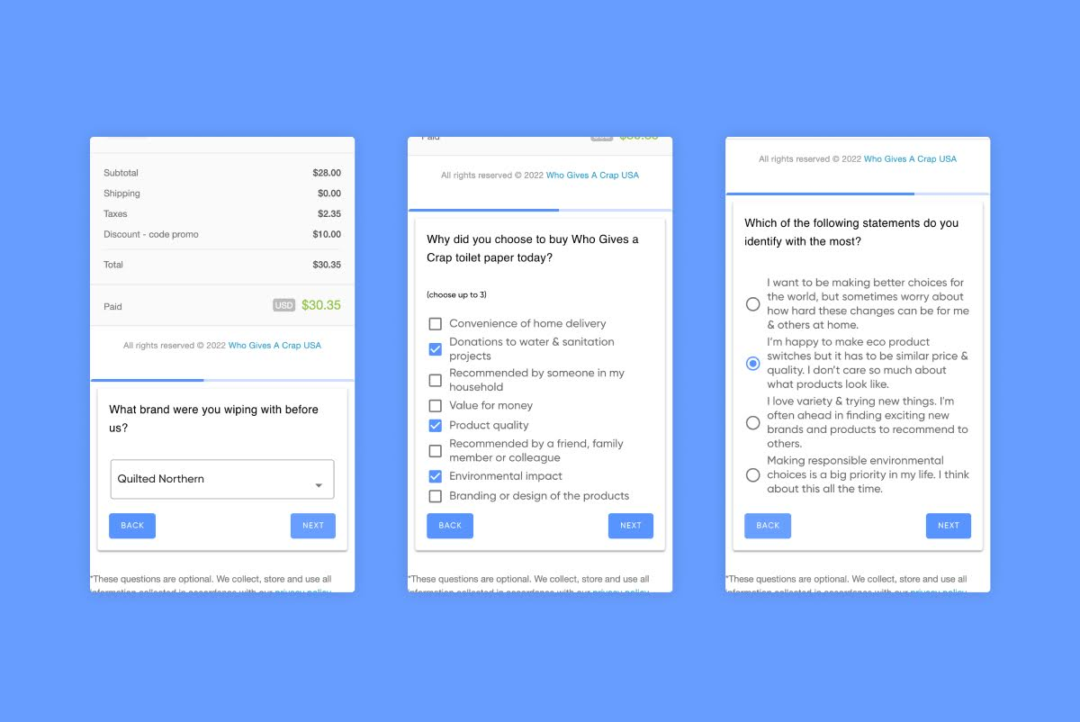
Who Gives a Crap, a sustainable toilet paper brand, asks customers how many people live in their household. A home with five people will go through toilet paper much faster than a single-person household, and knowing this allows for better-timed reorder prompts and personalized email flows, which, in turn, create much more loyal customers.
4. Use customer data for product development
Growth does not stop at marketing performance. In many cases, the biggest gains come from improving the product itself. Nearly 91% of brands believe innovation should be driven by customer insight, yet product decisions are still often shaped by internal assumptions, trend watching, or small pockets of feedback that may not represent the broader customer base.
The difference comes down to timing and intention.
Asking customers the right questions at the right moment turns everyday purchases into ongoing research and development across the entire roadmap for growth.
Instead of waiting for support tickets or negative reviews to surface problems, brands can proactively understand what customers want more of, what frustrates them, and what nearly stopped them from buying in the first place.
Some of the most valuable product insights come from surprisingly simple questions:
- “What features do you wish we had?” helps surface unmet needs customers may never share publicly.
- “What do you like most about this product?” highlights strengths worth doubling down on, especially when those answers repeat across responses.
- “What nearly stopped you from buying?” is a conversion-focused prompt that often uncovers product-level objections related to sizing, materials, or expectations.
For brands expanding successful product lines, surveys also help guide launches of new products by identifying demand early across different demographics.
Collecting feedback is only half the equation, but the real advantage comes from building systems that make insight actionable.
When survey responses connect directly to SKUs, product teams can filter feedback inside reporting dashboards by sentiment, satisfaction score, or feature request trends. Recurring complaints above a defined threshold can trigger alerts to product or operations teams, helping brands maintain high-quality standards while streamlining decision-making.
In other words, feedback stops being anecdotal and starts becoming operational.
Hexclad used this approach to guide research and development decisions after discovering through their customer feedback survey responses that nearly 30% of customers grilled at least five times per month. That single insight reshaped how the team thought about usage behavior and ultimately led to the launch of their summer grilling line.
Turn customer data into your biggest growth advantage with KnoCommerce
Every stage of your growth strategy, from acquisition and conversion to retention and product development, benefits from zero-party customer data.
When brands understand how customers discovered them, what influenced their purchase decision, and how their experience could improve, growth decisions become clearer and easier to act on.
KnoCommerce helps ecommerce brands collect that data through post-purchase surveys delivered across your website, email, SMS, and other customer touchpoints. Instead of relying on assumptions or incomplete attribution models, teams gain direct insight into customer motivations.
Those insights are designed to be actionable.
With powerful reporting, integrations across leading providers, and flexible audience filters, survey responses can inform marketing strategy, retention workflows, creative decisions, and product development initiatives.
If you’re ready to turn customer feedback into measurable growth, book a demo to see how KnoCommerce can help.